A Levels Biology (9700)•9700/13/M/J/24
A Levels Biology (9700) — 9700/13/M/J/24, Question 39
The events listed occur during the primary immune response to a specific pathogen.
1 activation of B-lymphocytes to produce plasma cells and memory cells
2 phagocytosis of invading pathogens by macrophages
3 T-helper cell activation and production of T-killer cells
4 release of antibodies surface
5 production and release of antibodies
Which row identifies the correct sequence of events?
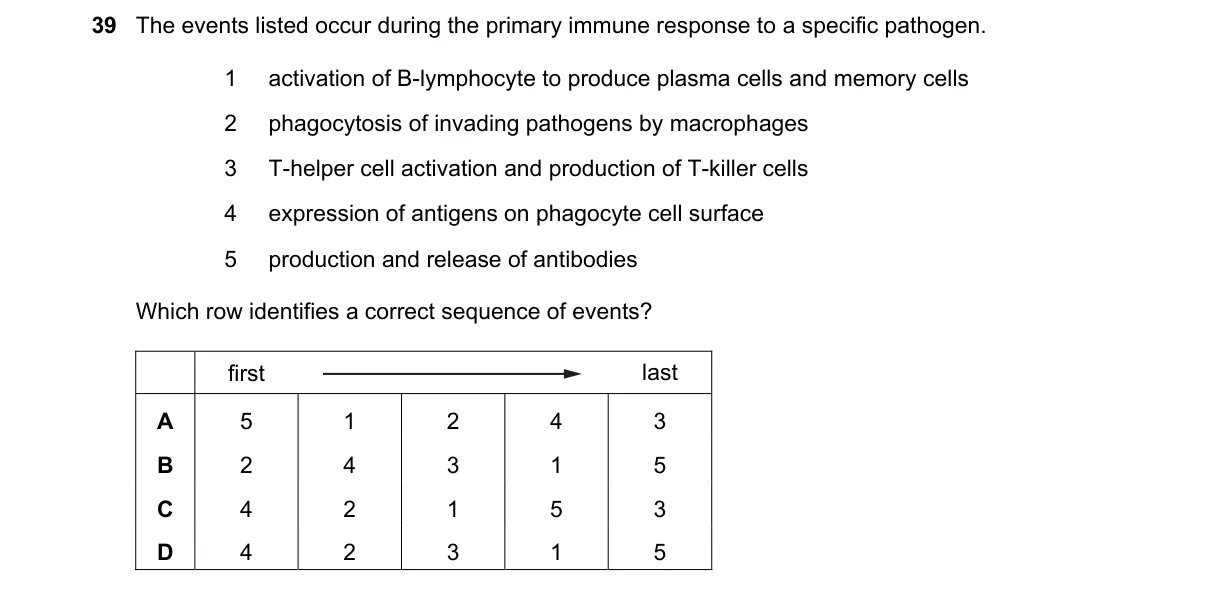
Answer choices
- A5 1 2 4 3
- B2 4 1 5 3
- C2 4 3 1 5
- D4 2 3 1 5
Explanation
Primary Immune Response Sequence
Steps:
- Pathogens enter body; macrophages phagocytose them (event 2) to process antigens.
- Processed antigens presented via surface molecules, including initial antibody display on B cells (event 4).
- T-helper cells activate (event 3), aiding cytotoxic T-killer production and B cell stimulation.
- Activated B cells differentiate into plasma and memory cells (event 1), leading to antibody production and release (event 5).
Why B is correct:
- Matches innate-to-adaptive progression: phagocytosis initiates antigen presentation (2-4), T-cell help (3) drives B-cell activation (1) and humoral response (5), per immunology's stepwise activation model.
Why the others are wrong:
- A: Starts with antibody release (5), skipping innate phagocytosis.
- C: Places T-helper activation (3) before B-cell differentiation (1), inverting helper-B cell dependency.
- D: Begins with unclear surface antibody release (4), preceding phagocytosis needed for antigen processing.
Final answer: B
Topic: The immune system
Practice more A Levels Biology (9700) questions on mMCQ.me