A Levels Biology (9700)•9700/13/M/J/24
A Levels Biology (9700) — 9700/13/M/J/24, Question 37
The antibiotic penicillin kills by inhibiting the synthesis of the cell walls of bacteria. Which type of bacteria will be killed by penicillin more easily and why?
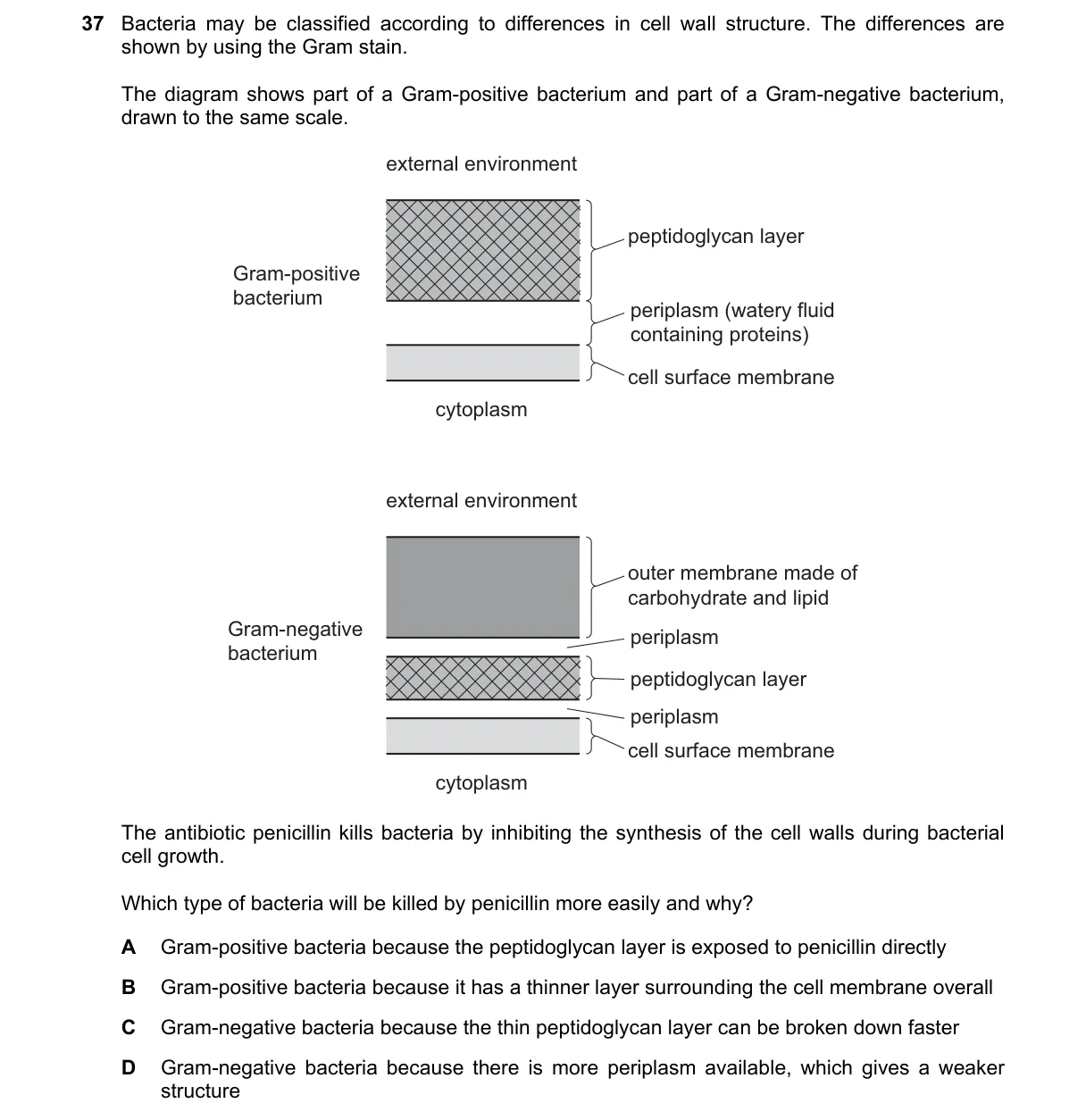
Answer choices
- AGram-positive bacteria because the peptidoglycan layer is exposed to penicillin directly
- BGram-negative bacteria because it has thinner peptidoglycan layer surrounding the cell membrane over
- COption C
- DGram-negative bacteria because there is more periplasm available, which gives a weaker
Explanation
Penicillin targets exposed peptidoglycan in Gram-positive bacteria
Steps:
- Penicillin inhibits peptidoglycan cross-linking in bacterial cell walls, preventing synthesis.
- Gram-positive bacteria have a thick peptidoglycan layer directly outside the plasma membrane, with no outer membrane barrier.
- Gram-negative bacteria have a thin peptidoglycan layer surrounded by an outer membrane, which blocks antibiotic entry.
- Thus, penicillin accesses and disrupts the target more easily in Gram-positive bacteria.
Why A is correct:
- Gram-positive cell walls lack an outer membrane, allowing direct exposure of the peptidoglycan layer to penicillin, as defined by Gram staining based on cell wall structure.
Why the others are wrong:
- B: Gram-negative bacteria's thinner peptidoglycan is protected by the outer membrane, reducing penicillin's effectiveness.
- C: Option is incomplete and provides no valid reasoning.
- D: More periplasm in Gram-negative bacteria does not weaken them; the outer membrane actually shields the peptidoglycan from penicillin.
Final answer: A
Topic: Antibiotics
Practice more A Levels Biology (9700) questions on mMCQ.me