A Levels Biology (9700)•9700/13/M/J/24
A Levels Biology (9700) — 9700/13/M/J/24, Question 34
Exchange of carbon dioxide and oxygen occurs between air in the alveoli and blood in the capillaries of the lung. Which partial pressures of the gases will allow gaseous exchange to occur?
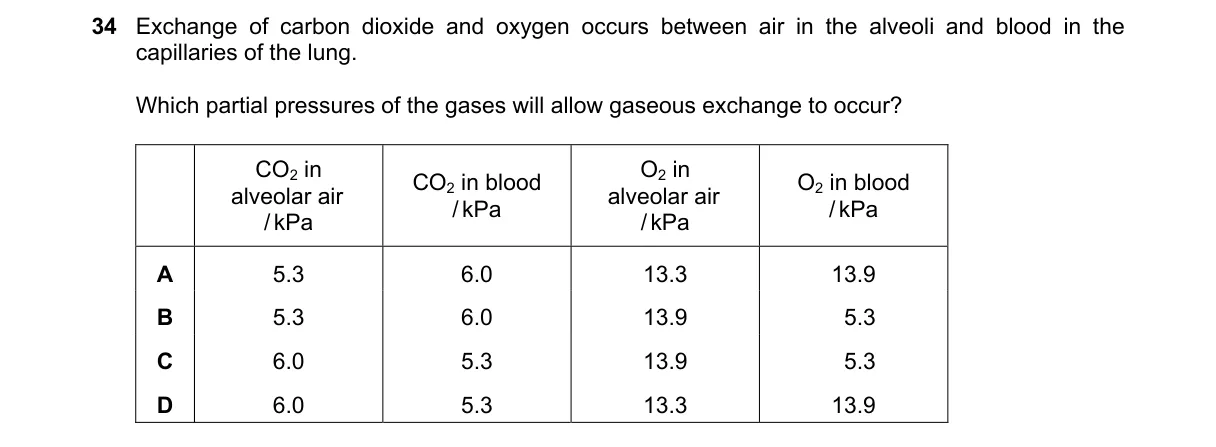
Answer choices
- ACO2 in alveoli air (kPa): 5.3, O2 in alveoli air (kPa): 6.0, CO2 in blood (kPa): 13.3, O2 in blood (kPa): 13.9
- BCO2 in alveoli air (kPa): 6.3, O2 in alveoli air (kPa): 5.3, CO2 in blood (kPa): 13.9, O2 in blood (kPa): 5.3
- CCO2 in alveoli air (kPa): 6.3, O2 in alveoli air (kPa): 5.3, CO2 in blood (kPa): 13.9, O2 in blood (kPa): 5.3
- DCO2 in alveoli air (kPa): 6.0, O2 in alveoli air (kPa): 5.3, CO2 in blood (kPa): 13.3, O2 in blood (kPa): 13.9
Explanation
Partial pressure gradients drive pulmonary gas exchange
Steps:
- Gases diffuse across the alveolar-capillary membrane from higher to lower partial pressure.
- Oxygen enters blood if PO₂ alveoli > PO₂ blood.
- Carbon dioxide exits blood if PCO₂ blood > PCO₂ alveoli.
- Evaluate options for gradients supporting both O₂ uptake and CO₂ elimination.
Why B is correct:
- B provides PCO₂ blood (13.9 kPa) > PCO₂ alveoli (6.3 kPa) for CO₂ diffusion to air, and PO₂ alveoli (5.3 kPa) = PO₂ blood (5.3 kPa) with no opposing gradient, per Fick's law of diffusion.
Why the others are wrong:
- A: PO₂ alveoli (6.0 kPa) < PO₂ blood (13.9 kPa), reversing O₂ flow out of blood.
- C: PCO₂ blood (5.3 kPa) < PCO₂ alveoli (6.3 kPa) and PO₂ blood (13.9 kPa) > PO₂ alveoli (5.3 kPa), reversing both flows.
- D: PO₂ alveoli (5.3 kPa) < PO₂ blood (13.9 kPa), reversing O₂ flow out of blood.
Final answer: B
Topic: The gas exchange system
Practice more A Levels Biology (9700) questions on mMCQ.me