A Levels Biology (9700)•9700/13/M/J/24
A Levels Biology (9700) — 9700/13/M/J/24, Question 2
What can be concluded about the eukaryotic cell from the electron micrograph?
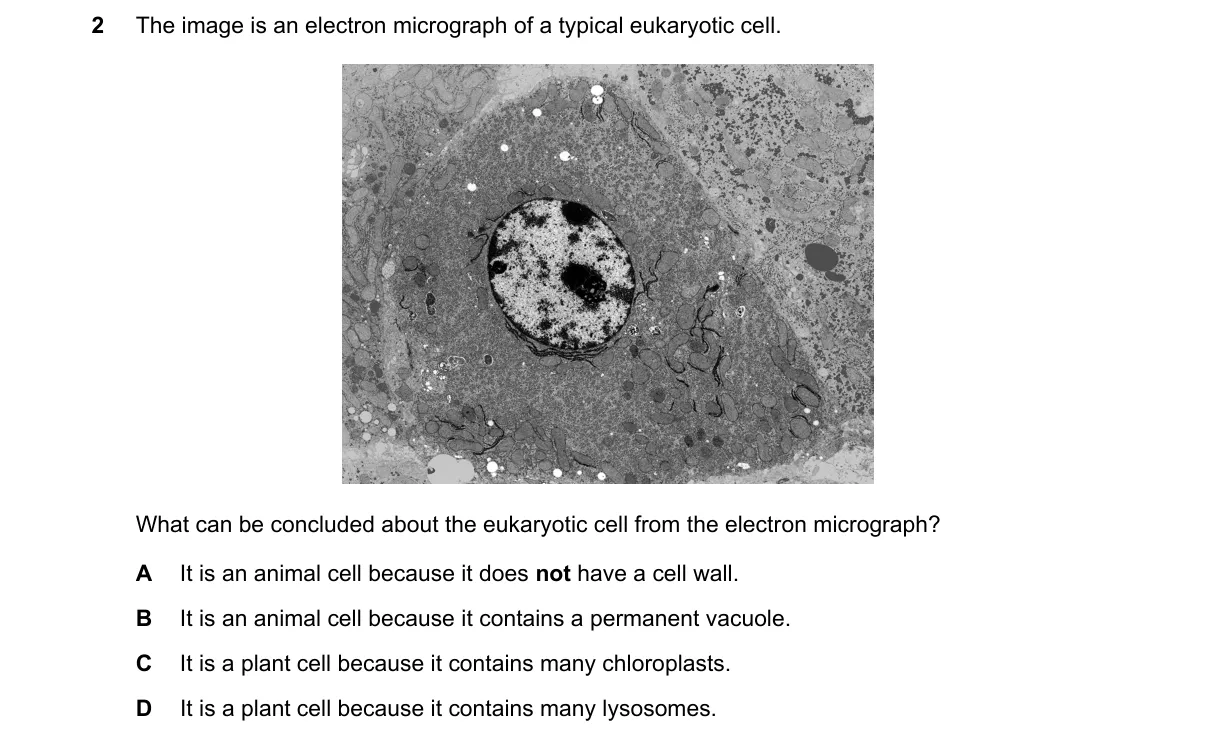
Answer choices
- AIt is an animal cell because it does not have a cell wall.
- BIt is a plant cell because it contains many chloroplasts.
- CIt is a plant cell because it contains many lysosomes.
- DIt is an animal cell because it does not have a permanent vacuole.
Explanation
Identifying eukaryotic cell type from structural features
Steps:
- Recall key differences: plant cells have cell walls and chloroplasts; animal cells lack these.
- Examine micrograph for cell wall: absence indicates no rigid outer layer typical of plants.
- Check for other plant markers like chloroplasts or large vacuoles: none visible.
- Conclude based on animal cell traits: flexible membrane without wall or permanent vacuole.
Why A is correct:
- Animal cells lack a cell wall, defined as a rigid structure of cellulose in plants for support, absent in animals for flexibility.
Why the others are wrong:
- B: Chloroplasts for photosynthesis are exclusive to plant cells; their absence rules out plant identification.
- C: Lysosomes for digestion are more prominent in animal cells, not a plant trait.
- D: Permanent vacuoles for storage are characteristic of plant cells; animal cells have small, temporary ones.
Final answer: A
Topic: Cells as the basic units of living organisms
Practice more A Levels Biology (9700) questions on mMCQ.me