A Levels Biology (9700)•9700/13/M/J/24
A Levels Biology (9700) — 9700/13/M/J/24, Question 11
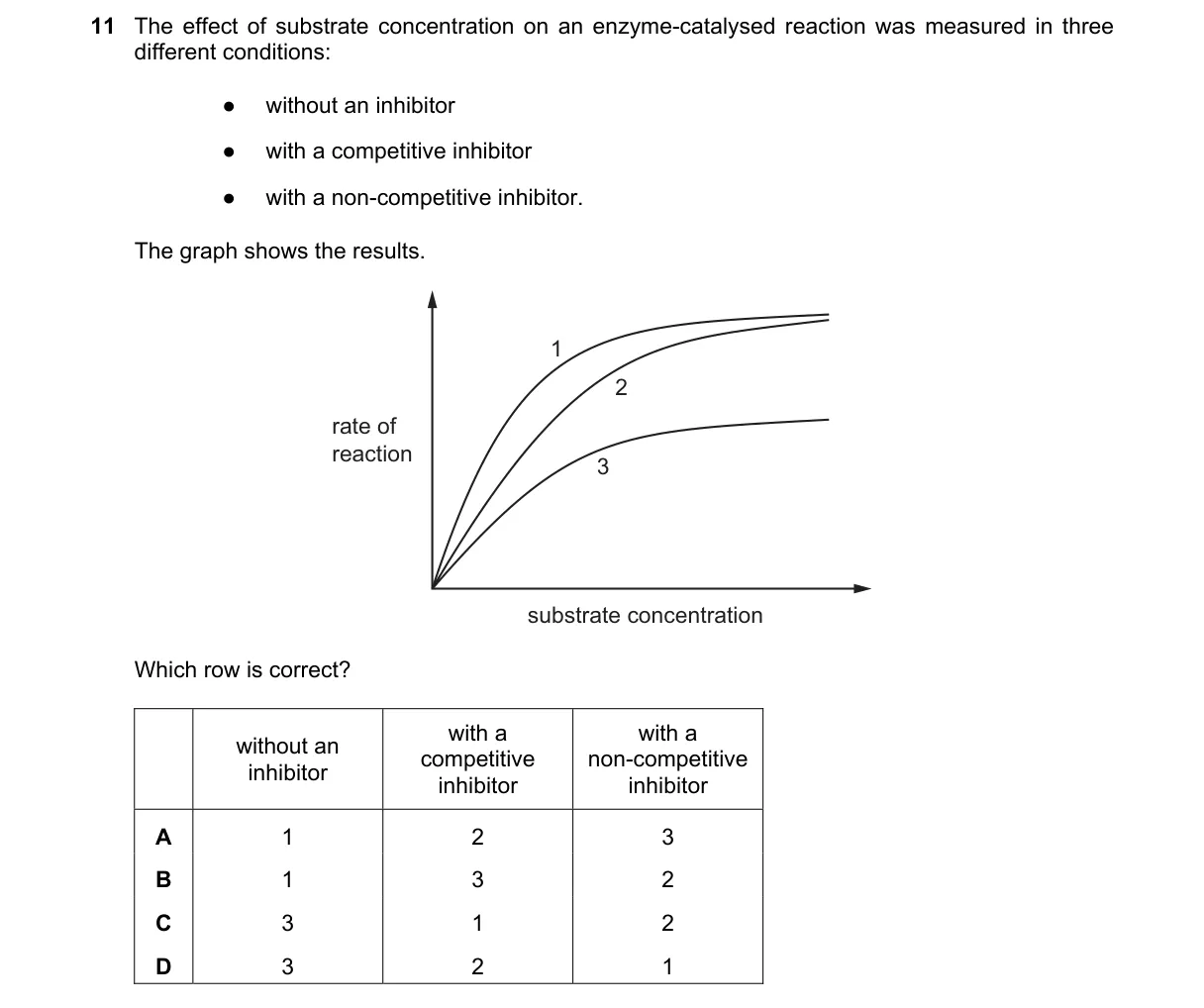
The effect of substrate concentration on an enzyme-catalysed reaction was measured in three different conditions: without an inhibitor, with a competitive inhibitor, with a non-competitive inhibitor. The graph shows the results. Which row is correct? without an inhibitor with a competitive inhibitor with a non-competitive inhibitor
Answer choices
- A1 2 3
- BOption B
- C3 1 2
- D3 2 1
Explanation
Enzyme inhibitor effects on Michaelis-Menten curves
Steps:
- Without inhibitor: hyperbolic curve with baseline Km (x-intercept) and Vmax (y-max).
- Competitive inhibitor: increases Km (shifts curve right), Vmax unchanged.
- Non-competitive inhibitor: decreases Vmax (lowers asymptote), Km unchanged.
- Match graph lines: line 1 (highest Vmax, lowest Km) = no inhibitor; line 2 (same Vmax, higher Km) = competitive; line 3 (lower Vmax, same Km) = non-competitive.
Why A is correct:
- Matches standard kinetics: competitive alters Km via [I]/(1+[I]) factor in Michaelis-Menten equation; non-competitive reduces Vmax by binding non-active site.
Why the others are wrong:
- B: Swaps competitive and non-competitive, ignoring Km specificity.
- C: Misassigns no inhibitor to line 3, which has reduced Vmax.
- D: Reverses all, confusing Vmax depression with Km shift.
Final answer: A
Topic: Factors that affect enzyme action
Practice more A Levels Biology (9700) questions on mMCQ.me