A Levels Biology (9700)•9700/12/M/J/24
A Levels Biology (9700) — 9700/12/M/J/24, Question 8
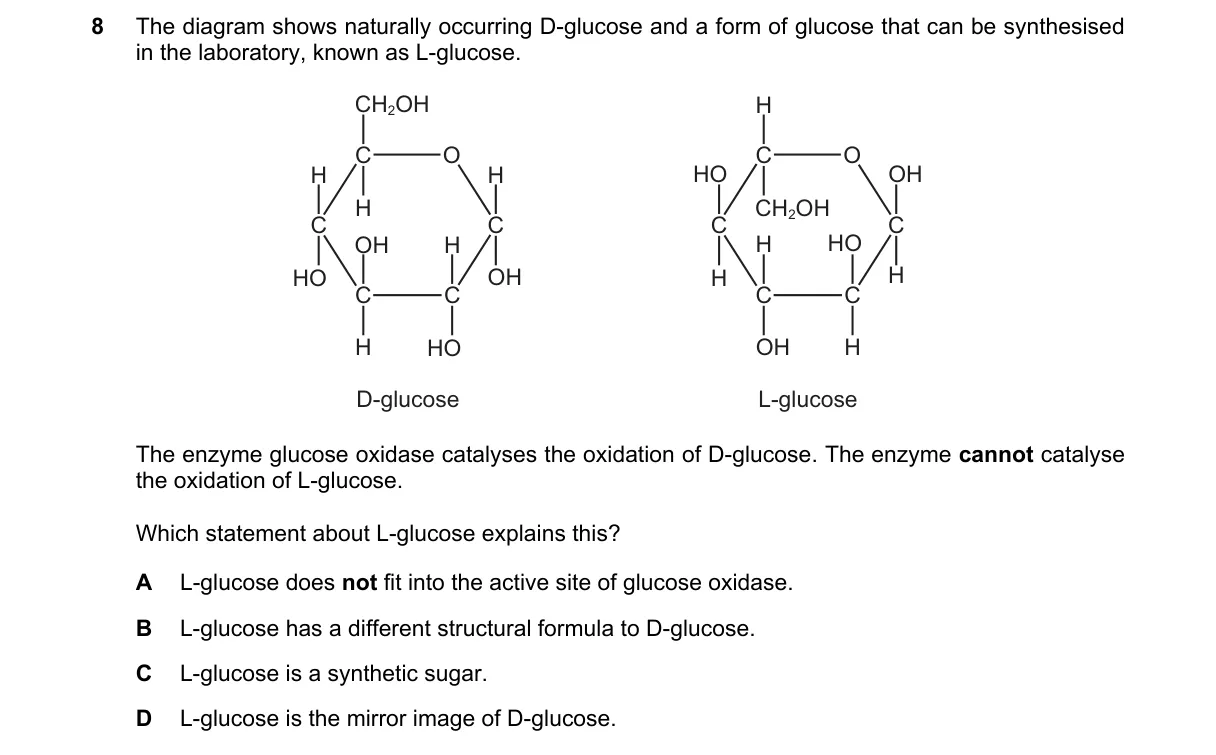
The diagram shows naturally occurring D-glucose and a form of glucose that can be synthesised in the laboratory, known as L-glucose. The enzyme glucose oxidase catalyses the oxidation of D-glucose. The enzyme cannot catalyse the oxidation of L-glucose. Which statement about L-glucose explains this?
Answer choices
- AL-glucose does not fit into the active site of glucose oxidase.
- BL-glucose has a different structural formula to D-glucose.
- CL-glucose is the mirror image of D-glucose.
- DL-glucose is a synthetic sugar.
Explanation
Enzyme Stereospecificity in Glucose Oxidation
Steps:
- D-glucose and L-glucose are enantiomers, mirror-image stereoisomers with identical connectivity but opposite configurations at chiral centers.
- Enzymes like glucose oxidase have chiral active sites shaped to bind only one enantiomer precisely.
- L-glucose's opposite configuration prevents it from fitting the active site, blocking catalysis.
- This specificity ensures the enzyme oxidizes only the natural D-form.
Why A is correct:
- Enzymes exhibit stereospecificity; their active sites are complementary to the precise 3D shape of the substrate enantiomer, as per the lock-and-key model.
Why the others are wrong:
- B: Enantiomers share the same structural formula (connectivity) but differ in spatial arrangement.
- C: Mirror-image status describes the relationship but does not explain the catalytic failure—fit into the active site does.
- D: Synthetic origin is irrelevant; enzyme activity depends on molecular shape, not production method.
Final answer: A
Topic: Mode of action of enzymes
Practice more A Levels Biology (9700) questions on mMCQ.me