A Levels Biology (9700)•9700/12/M/J/24
A Levels Biology (9700) — 9700/12/M/J/24, Question 36
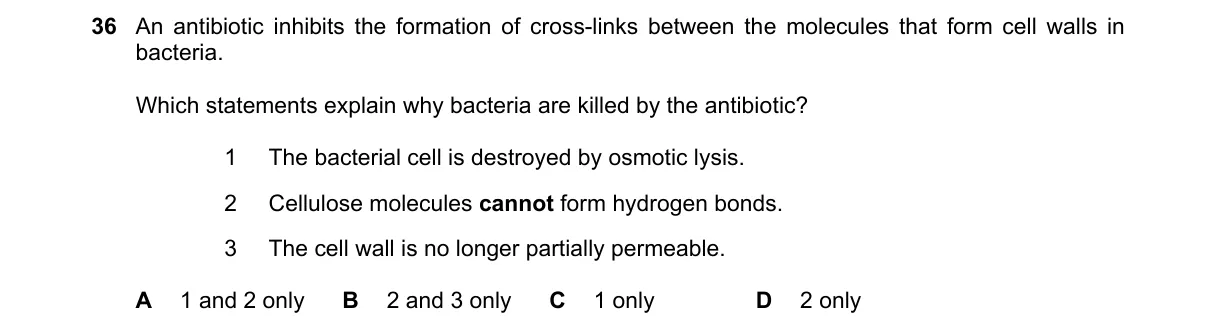
An antibiotic inhibits the formation of cross-links between the molecules that form cell walls in bacteria. Which statements explain why bacteria are killed by osmotic lysis?
1 The bacterial cell is destroyed by osmotic lysis.
2 Cellulose molecules cannot form hydrogen bonds.
3 The cell wall is no longer partly permeable.
Answer choices
- A1 and 3
- B2 and 3
- C1 only
- D2 only
Explanation
Antibiotic disrupts bacterial cell wall integrity causing osmotic rupture
Steps:
- Antibiotic blocks cross-links in peptidoglycan, the key component of bacterial cell walls.
- This weakens the wall's rigidity, preventing it from resisting internal turgor pressure.
- In hypotonic environments, water enters the cell via osmosis, swelling it uncontrollably.
- The fragile wall bursts, destroying the cell through lysis as described in statement 1.
Why C is correct:
- Statement 1 directly identifies osmotic lysis as the destructive mechanism, aligning with the definition of hypotonic lysis where weakened walls fail under osmotic pressure.
Why the others are wrong:
- A includes 3, but cell walls are not "partly permeable"; permeability relates to the plasma membrane, not wall structure.
- B includes 2 and 3; 2 is irrelevant as bacterial walls use peptidoglycan, not cellulose, which forms hydrogen bonds in plants.
- D relies only on 2, which misapplies plant cell biology to bacteria.
Final answer: C
Topic: Antibiotics
Practice more A Levels Biology (9700) questions on mMCQ.me