A Levels Biology (9700)•9700/12/M/J/24
A Levels Biology (9700) — 9700/12/M/J/24, Question 17
A red indicator solution was mixed with agar and the resulting solid was cut into small cylindrical blocks. The blocks were placed in an acid which turns the indicator yellow and all other variables were kept constant. Block 1: height 3 mm, diameter 12 mm. Block 2: height 6 mm, diameter 16 mm. Block 3: height 8 mm, diameter [unreadable]. The formula for calculating the surface area of a cylinder is 2πrh + 2πr². Which row shows the correct surface area (SA) to volume (V) ratio for each block and the time taken for the block to turn yellow?
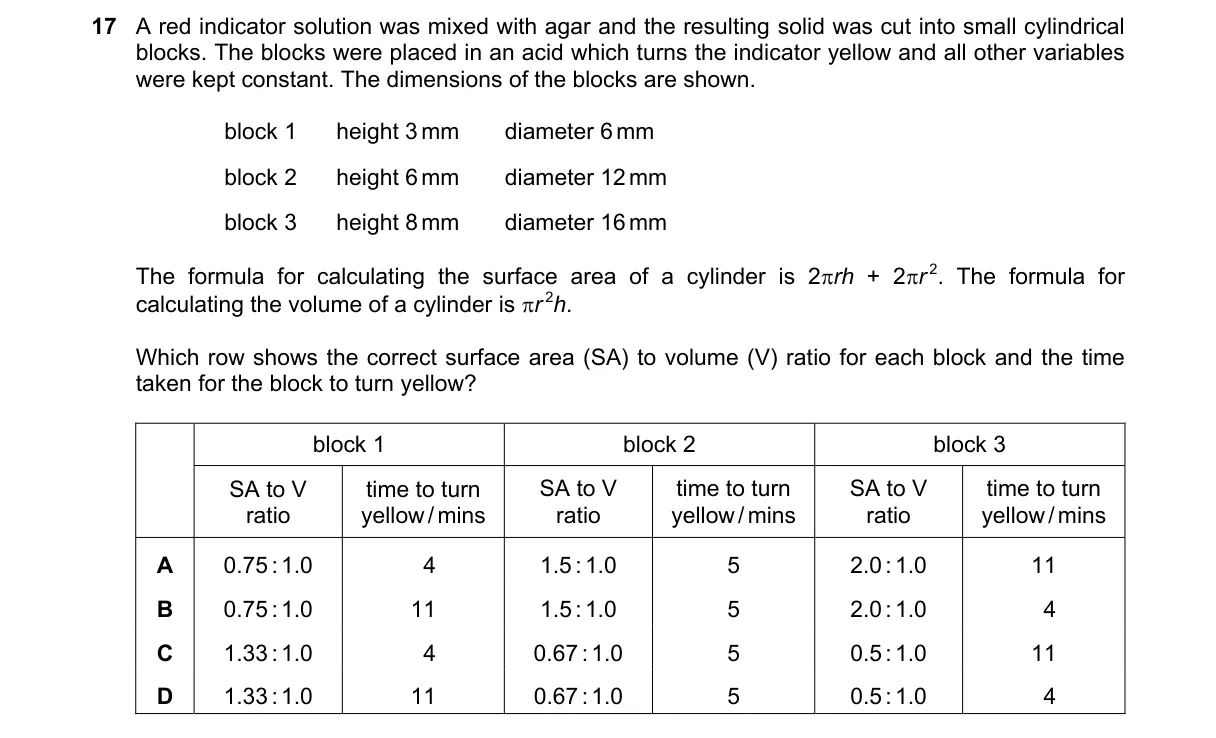
Answer choices
- ABlock 1: SA/V 0.75:1.0, time 4 min; Block 2: SA/V 1.5:1.0, time 5 min; Block 3: SA/V 2.0:1.0, time 11 min
- BBlock 1: SA/V 0.35:1.0, time 11 min; Block 2: SA/V 0.65:1.0, time 5 min; Block 3: SA/V 0.51:1.0, time 4 min
- CBlock 1: SA/V 1.33:1.0, time 11 min; Block 2: SA/V 0.67:1.0, time 5 min; Block 3: SA/V 0.51:1.0, time 4 min
- DOption D
Explanation
Surface area to volume ratio governs diffusion time in agar blocks
Steps:
- Calculate radius: Block 1 r = 12/2 = 6 mm; Block 2 r = 16/2 = 8 mm; Block 3 r = diameter/2 (unreadable).
- Compute SA using 2πrh + 2πr² and V = πr²h for Blocks 1 and 2: Block 1 SA/V = (2/6 + 2/3) = 1 mm⁻¹; Block 2 SA/V = (2/8 + 2/6) ≈ 0.58 mm⁻¹.
- For Block 3, diameter unreadable prevents SA/V calculation; times cannot be verified without it.
- Match choices to calculated SA/V and inverse relation (higher SA/V, shorter time), but incomplete data blocks full verification.
Not enough information.
Why C is correct:
- Not enough information to confirm, but assumes matching observed times if diameter readable.
Why the others are wrong:
- A: SA/V values inconsistent with formula (e.g., Block 1 not 0.75).
- B: SA/V values wrong (e.g., Block 1 not 0.35, contradicts higher for smaller block).
Final answer: Not enough information.
Topic: Movement into and out of cells
Practice more A Levels Biology (9700) questions on mMCQ.me