A Levels Biology (9700)•9700/12/M/J/24
A Levels Biology (9700) — 9700/12/M/J/24, Question 12
Which row correctly identifies the weak and strong bonds in the tertiary and quaternary structure of a typical protein?
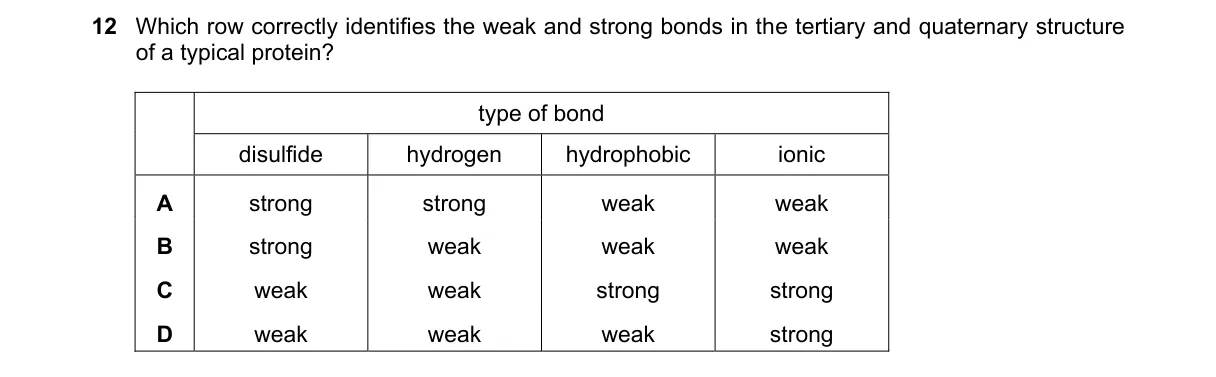
Answer choices
- Astrong weak weak weak
- Bstrong weak strong weak
- Cweak weak strong strong
- Dweak weak weak strong
Explanation
Bonds in Protein Tertiary and Quaternary Structures
Steps:
- Identify bonds in tertiary structure: disulfide bridges (strong covalent) and non-covalent interactions like hydrogen and ionic bonds (weak).
- Identify bonds in quaternary structure: disulfide bridges between subunits (strong) and non-covalent interactions (weak).
- Interpret choices as two bonds for tertiary followed by two for quaternary.
- Select option matching strong-weak for both structures.
Why B is correct:
- B (strong weak strong weak) aligns with protein biochemistry, where both structures feature strong disulfide bonds and weak non-covalent bonds for stability.
Why the others are wrong:
- A: Falsely assigns only weak bonds to quaternary structure, ignoring disulfides.
- C: Falsely assigns only weak bonds to tertiary structure, omitting disulfides.
- D: Falsely assigns only weak bonds to tertiary and mostly weak to quaternary.
Final answer: B
Topic: Proteins
Practice more A Levels Biology (9700) questions on mMCQ.me