A Levels Biology (9700)•9700/11/M/J/24
A Levels Biology (9700) — 9700/11/M/J/24, Question 35
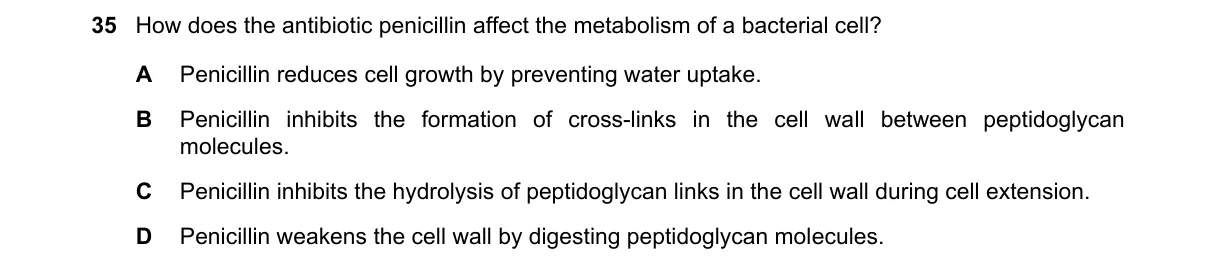
How does the antibiotic penicillin affect the metabolism of a bacterial?
Answer choices
- APenicillin inhibits the growth by preventing water uptake
- BPenicillin inhibits the formation of cross-links in the cell wall between peptidoglycan
- CPenicillin inhibits the hydrolysis of peptidoglycan links in the cell during cell extension.
- DPenicillin weakens the cell wall by digesting peptidoglycan molecules.
Explanation
Penicillin Targets Peptidoglycan Cross-Linking
Steps:
- Recall that bacterial cell walls contain peptidoglycan, a polymer providing structural integrity.
- Penicillin binds to penicillin-binding proteins (PBPs) like transpeptidases during cell wall synthesis.
- This binding blocks the enzyme's role in forming cross-links between peptidoglycan chains.
- Without cross-links, the cell wall weakens, leading to lysis and bacterial death.
Why B is correct:
- Penicillin specifically inhibits transpeptidase enzymes, preventing covalent cross-links in peptidoglycan as defined in bacterial cell wall biosynthesis.
Why the others are wrong:
- A: Penicillin does not affect water uptake; that's more related to osmotic pressure changes post-wall damage.
- C: Penicillin does not inhibit hydrolysis; autolysins handle peptidoglycan breakdown during growth.
- D: Penicillin does not digest peptidoglycan; it blocks new synthesis, not enzymatic degradation.
Final answer: B
Topic: Antibiotics
Practice more A Levels Biology (9700) questions on mMCQ.me