A Levels Biology (9700)•9700/11/M/J/24
A Levels Biology (9700) — 9700/11/M/J/24, Question 33
Steep concentration gradients must be maintained for efficient gaseous exchange to occur in the human lungs. Which row correctly describes how steep concentration gradients can be maintained?
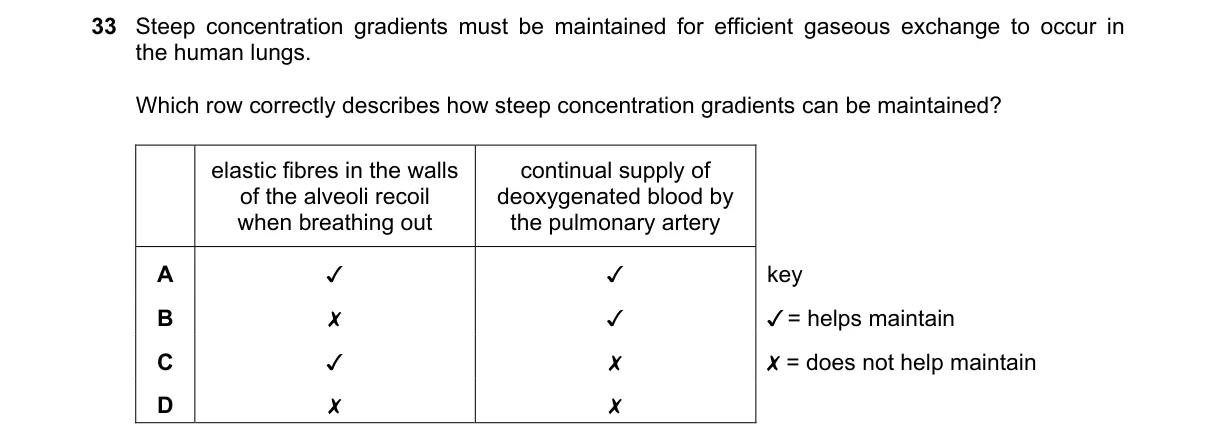
Answer choices
- Aelastic fibres in the walls of the alveoli recoil when breathing out helps maintain; deoxygenated blood by the pulmonary artery helps maintain
- Belastic fibres in the walls of the alveoli recoil when breathing out does not help maintain; deoxygenated blood by the pulmonary artery does not help maintain
- Celastic fibres in the walls of the alveoli recoil when breathing out does not help maintain; deoxygenated blood by the pulmonary artery helps maintain
- Delastic fibres in the walls of the alveoli recoil when breathing out helps maintain; deoxygenated blood by the pulmonary artery does not help maintain
Explanation
Maintaining diffusion gradients via ventilation and perfusion
Steps:
- Steep gradients require constant renewal of O2 in alveoli and low O2 in incoming blood for diffusion.
- Elastic recoil in alveoli during exhalation expels CO2-rich air, allowing fresh O2 intake.
- Pulmonary artery delivers deoxygenated blood, ensuring continuous low O2 levels for uptake.
- Both processes sustain gradients by preventing equilibrium.
Why A is correct:
- Elastic recoil facilitates ventilation to refresh alveolar gases; pulmonary artery supplies deoxygenated blood to maintain low pulmonary O2, per Fick's law of diffusion.
Why the others are wrong:
- B: Incorrectly denies both mechanisms' roles in gradient maintenance.
- C: Wrongly dismisses elastic recoil's ventilation aid.
- D: Erroneously rejects pulmonary artery's perfusion contribution.
Final answer: A
Topic: The gas exchange system
Practice more A Levels Biology (9700) questions on mMCQ.me