A Levels Biology (9700)•9700/11/M/J/24
A Levels Biology (9700) — 9700/11/M/J/24, Question 28
Which conclusion is supported by the graph?
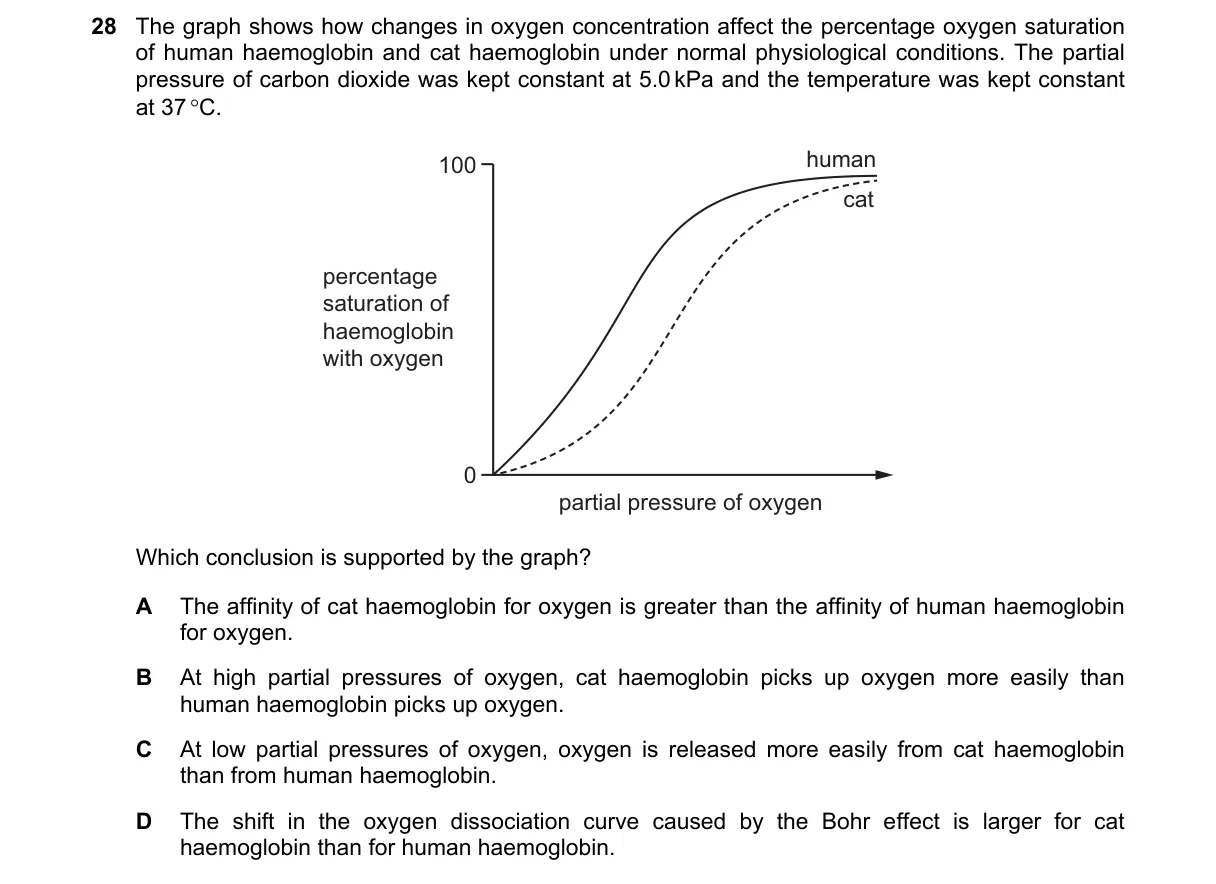
Answer choices
- AAt high partial pressures of oxygen, the affinity of cat haemoglobin for oxygen is greater than the affinity of human haemoglobin
- BAt low partial pressures of oxygen, cat haemoglobin picks up oxygen more easily than human haemoglobin
- CThe shift in the oxygen dissociation curve caused by the Bohr effect is larger for cat haemoglobin than for human haemoglobin
- DOption D
Explanation
Comparing Bohr Effect in Cat and Human Haemoglobin Curves
Steps:
- Identify standard (pH 7.4) and Bohr-shifted (low pH) curves for both haemoglobins on the graph.
- Note oxygen affinity by curve position: leftward shift indicates higher affinity (lower P50).
- Measure horizontal shift (ΔP50) between standard and low-pH curves for each type.
- Compare ΔP50 values: cat shows larger shift than human.
Why C is correct:
- The Bohr effect is quantified by the rightward shift in the oxygen dissociation curve (increased P50) at low pH due to H+ binding; cat haemoglobin's greater ΔP50 confirms a larger effect.
Why the others are wrong:
- A: At high PO2 (>80 mmHg), cat curve is right-shifted vs. human, indicating lower, not greater, affinity.
- B: At low PO2 (<20 mmHg), human curve is left of cat's, so human picks up oxygen more easily.
- D: Not enough information (option incomplete).
Final answer: C
Topic: Transport of oxygen and carbon dioxide
Practice more A Levels Biology (9700) questions on mMCQ.me