A Levels Biology (9700)•9700/11/M/J/24
A Levels Biology (9700) — 9700/11/M/J/24, Question 15
A student observed the effect of two different concentrations of salt solution on blood cells. A small drop of each blood was added to salt solution on two microscope slides, and then each slide was viewed using the high power lens of a microscope and the student's observations were recorded. Slide 1 No red blood cells were visible. Blood looked slightly shrivelled. Slide 2 The red blood cells were visible. Blood looked slightly crenated. Which correctly explains the results observed?
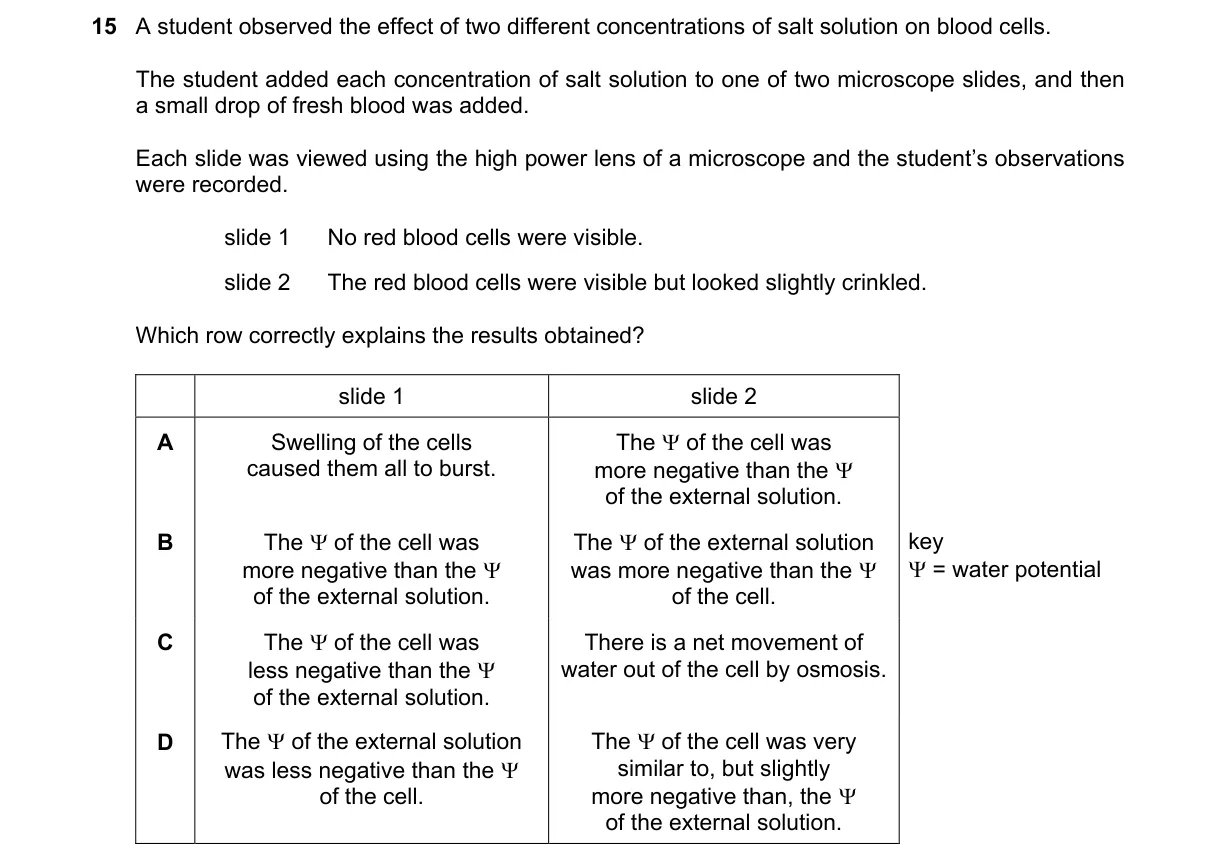
Answer choices
- ASwelling of the cells caused them to burst. The V of slide 2 was more negative than the V of the external solution.
- BThe V of the cells was more negative than the V. The V of the external solution was more negative than the V.
- CThe V of the solution was less negative than the V. There is a net of the cell by osmosis.
- DThe V of the external solution was less negative than the V. The V of the cell by osmosis more similar to, slightly V of the external solution.
Explanation
Water Potential Gradients in Osmosis
Steps:
- Slide 1 shows no visible RBCs and shrivelled blood, indicating hypotonic solution where cells swelled and burst from water influx.
- Slide 2 shows visible, crenated RBCs, indicating hypertonic solution where cells shrank from water efflux.
- Water moves across membranes from higher (less negative) to lower (more negative) water potential (ψ).
- Slide 1 external ψ > cell ψ; slide 2 external ψ < cell ψ, explaining observations.
Why B is correct:
- B accurately describes slide 1 cell ψ more negative than external ψ (water enters, causing burst) and slide 2 external ψ more negative than cell ψ (water exits, causing crenation), following the osmosis rule that water flows down ψ gradients.
Why the others are wrong:
- A: Identifies swelling and bursting correctly but reverses ψ comparison for slide 2.
- C: Incorrectly states solution ψ less negative and confuses net osmosis direction.
- D: Falsely claims ψ becomes similar via osmosis and vaguely describes movement.
Final answer: B
Topic: Movement into and out of cells
Practice more A Levels Biology (9700) questions on mMCQ.me