A Levels Biology (9700)•9700/11/M/J/24
A Levels Biology (9700) — 9700/11/M/J/24, Question 13
The diagram shows how nicotine is transported from the blood plasma into a cell using a type of mechanism. Nicotine is transported from the blood plasma into the cell against its concentration gradient out of the cell. In the cytoplasm of the phloem sieve tube, there is a cotransporter mechanism that moves sucrose into the cytoplasm of the cell. Which statement correctly describes a similarity between the cotransport of nicotine and the cotransport of sucrose?
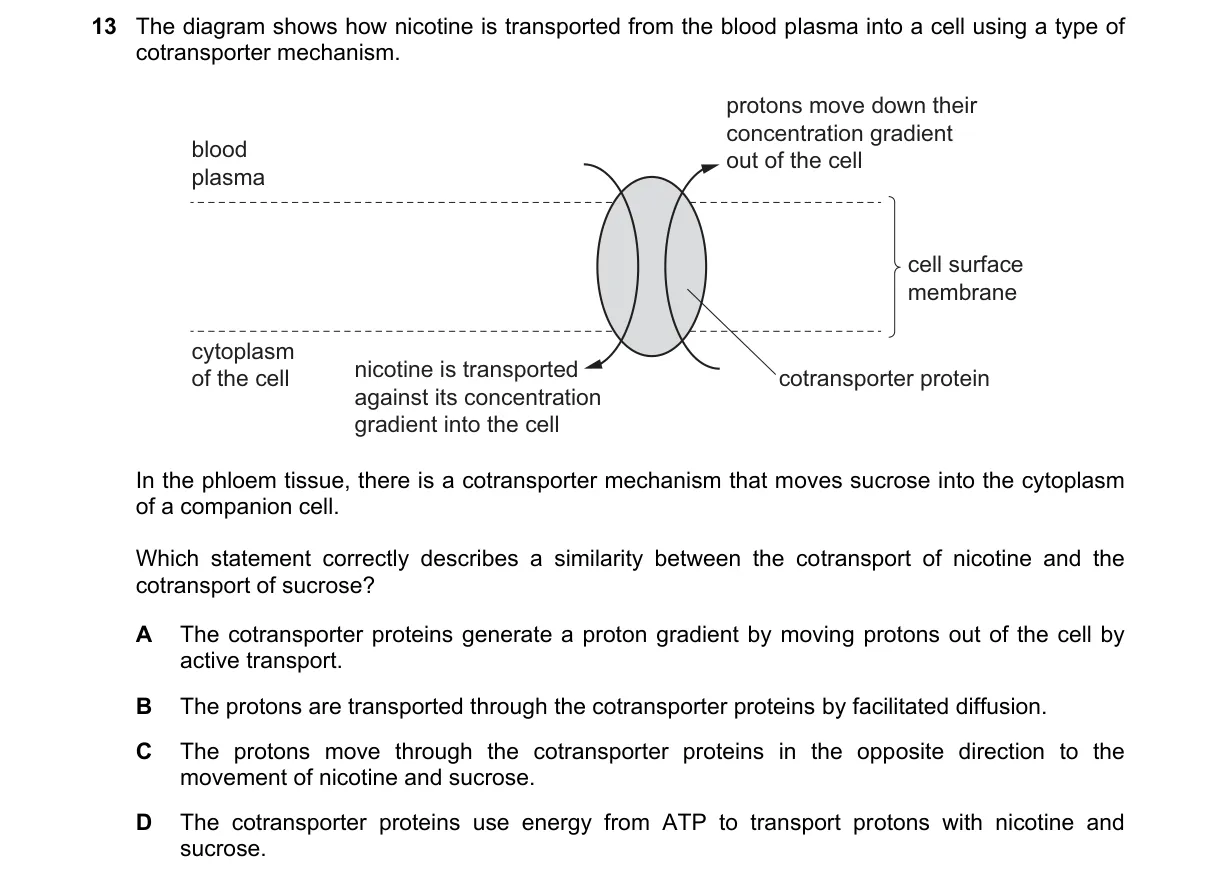
Answer choices
- AThe cotransporter proteins generate a proton gradient by moving protons out of the cell by
- BThe protons are transported through the cotransporter proteins by facilitated diffusion.
- CThe cotransporter proteins move and sucrose cotransporter proteins in the opposite direction to the
- Dsucrose cotransporter proteins use energy from ATP to transport protons with nicotine and sucrose into the cell.
Explanation
Proton facilitated diffusion drives both cotransports
Steps:
- Both nicotine and sucrose cotransports are secondary active transports using proton gradients.
- Protons move down their electrochemical gradient into the cell, powering uphill solute movement.
- This proton influx occurs via facilitated diffusion through cotransporter proteins.
- Option B matches this shared proton mechanism.
Why B is correct:
- Cotransport definition: Protons enter cells by facilitated diffusion down their gradient, coupling to solute uptake against its gradient.
Why the others are wrong:
- A: Cotransporters use existing proton gradients; they do not generate them (that's ATP-driven proton pumps).
- C: Incomplete, but cotransporters move protons and solutes in the same direction, not opposite.
- D: Cotransporters rely on proton gradients, not direct ATP hydrolysis for proton or solute transport.
Final answer: B
Topic: Movement into and out of cells
Practice more A Levels Biology (9700) questions on mMCQ.me