A Levels Biology (9700)•9700/13/M/J/23
A Levels Biology (9700) — 9700/13/M/J/23, Question 30
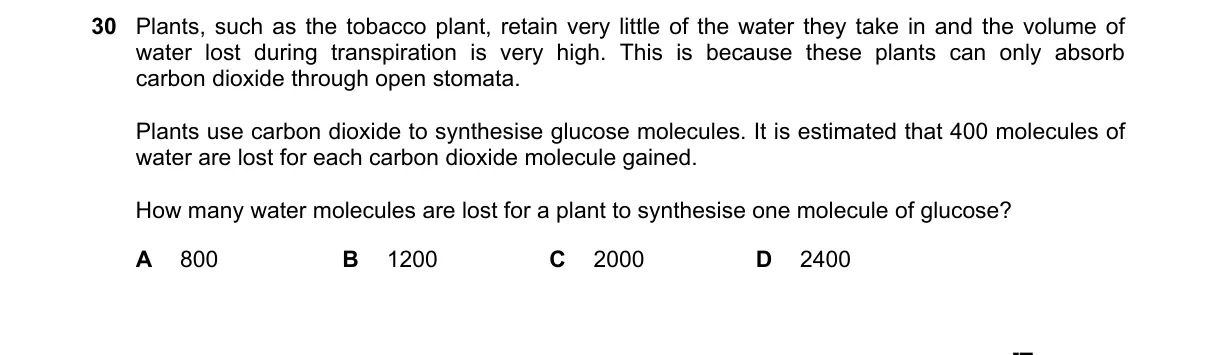
Plants, such as tobacco, retain very little of the water they take in and the volume of water lost during transpiration is very high. This is because these plants can only absorb carbon dioxide through open stomata. Plants use carbon dioxide to synthesise glucose. It is estimated that 400 molecules of water are lost for each carbon dioxide molecule gained. How many water molecules are lost for a plant to synthesise one molecule of glucose?
Answer choices
- A800
- B1200
- C2000
- D2400
Explanation
Water loss ratio in photosynthesis
Steps:
- Photosynthesis equation: 6 CO₂ + 6 H₂O → C₆H₁₂O₆ + 6 O₂, requiring 6 CO₂ per glucose.
- Plants lose 400 H₂O per CO₂ gained through open stomata.
- Calculate total loss: 6 CO₂ × 400 H₂O/CO₂ = 2400 H₂O.
- This accounts for CO₂ fixation during glucose synthesis.
Why D is correct:
- Balanced photosynthesis equation mandates 6 CO₂ molecules for one glucose, yielding 6 × 400 = 2400 H₂O lost.
Why the others are wrong:
- A: Assumes only 2 CO₂ (800 H₂O), ignoring full equation.
- B: Assumes 3 CO₂ (1200 H₂O), undercounting CO₂ needs.
- C: Assumes 5 CO₂ (2000 H₂O), still short of 6 required.
Final answer: D
Topic: Photosynthesis as an energy transfer process
Practice more A Levels Biology (9700) questions on mMCQ.me