A Levels Biology (9700)•9700/13/M/J/23
A Levels Biology (9700) — 9700/13/M/J/23, Question 29
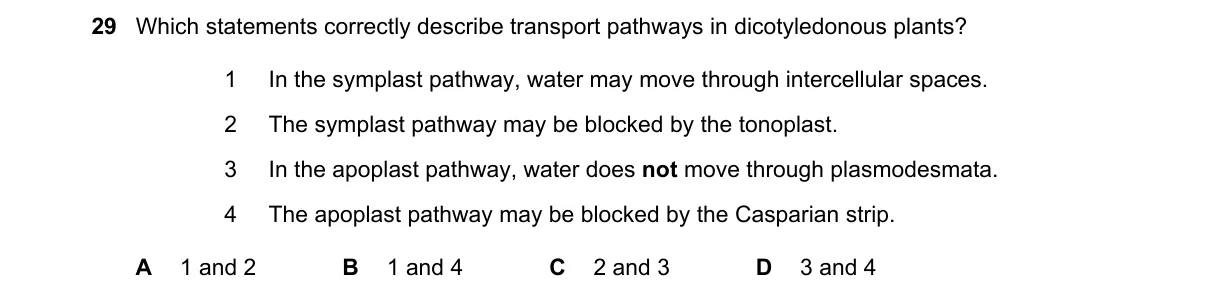
Which statements correctly describe transport pathways in dicotyledonous plants? 1 In the symplast pathway, water moves through intercellular spaces. 2 The symplast pathway may be blocked by the tonoplast. 3 In the apoplast pathway, water does not move through plasmodesmata. 4 The apoplast pathway may be blocked by the Casparian strip.
Answer choices
- A1 and 2
- B1 and 4
- C2 and 3
- D3 and 4
Explanation
Symplast vs. Apoplast Water Transport in Plants
Steps:
- Define symplast pathway: water moves cell-to-cell via cytoplasm and plasmodesmata, excluding intercellular spaces.
- Define apoplast pathway: water flows through cell walls and intercellular spaces, bypassing plasma membranes and plasmodesmata.
- Evaluate statement 1: false, as symplast avoids intercellular spaces.
- Evaluate statements 2–4: statement 2 false, tonoplast (vacuolar membrane) does not block cell-to-cell symplast movement; statements 3 and 4 true, apoplast excludes plasmodesmata and is blocked by Casparian strip in endodermis.
Why D is correct:
- Statements 3 and 4 match apoplast definition: extracellular flow without plasmodesmata, halted by Casparian strip's impermeable lignin barrier forcing symplastic entry.
Why the others are wrong:
- A includes false statement 1 (symplast uses plasmodesmata, not spaces).
- B includes false statement 1.
- C includes false statement 2 (tonoplast separates vacuole from cytoplasm but doesn't block symplast).
Final answer: D
Topic: Transport mechanisms
Practice more A Levels Biology (9700) questions on mMCQ.me