A Levels Biology (9700)•9700/13/M/J/23
A Levels Biology (9700) — 9700/13/M/J/23, Question 27
Which row correctly explains how the structures of phloem tube elements and xylem vessel elements relate to their functions as transport vessels
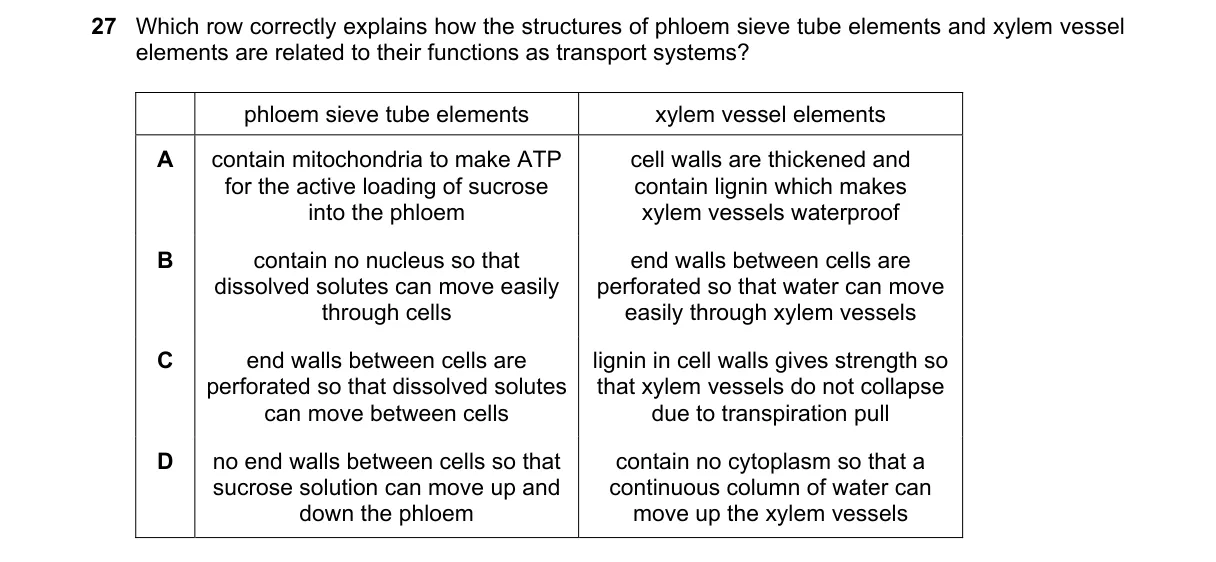
Answer choices
- Aphloem tube elements contain mitochondria to make ATP for active loading of sucrose; xylem vessel elements cell walls are thickened and contain lignin which makes them strong
- Bphloem tube elements contain no nucleus so; xylem vessel elements end walls between cells are perforated so water can move easily through
- Cphloem tube elements end walls between cells are perforated so dissolved solutes can move easily through; xylem vessel elements lignin in cell walls gives strength so that continuous column of water can move up the xylem vessels
- Dphloem tube elements no end walls between cells so that dissolved solutes can move; xylem vessel elements contain no cytoplasm so due to transport pull
Explanation
Structural Adaptations in Phloem and Xylem for Transport
Steps:
- Recall phloem transports sugars via sieve tubes with perforated end walls (sieve plates) for solute flow.
- Recall xylem transports water via vessels with lignified walls for strength and perforated end walls for continuous flow.
- Evaluate each option for accurate structure-function links without errors.
- Select option matching both: perforated phloem ends for solutes and lignified xylem walls for water column support.
Why C is correct:
- Phloem sieve plates (perforated end walls) allow mass flow of solutes; xylem lignification provides tensile strength per Hooke's law for upward water transport against gravity.
Why the others are wrong:
- A: Phloem mitochondria aid loading but not tube structure; xylem lignin is correct but incomplete pairing.
- B: Phloem tubes have nuclei in companion cells, not absent; xylem perforation is accurate but phloem part wrong.
- D: Phloem has sieve plates, not no end walls; xylem lacks cytoplasm but transport relies on cohesion-tension, not just that.
Final answer: C
Topic: Structure of transport tissues
Practice more A Levels Biology (9700) questions on mMCQ.me