A Levels Biology (9700)•9700/13/M/J/23
A Levels Biology (9700) — 9700/13/M/J/23, Question 25
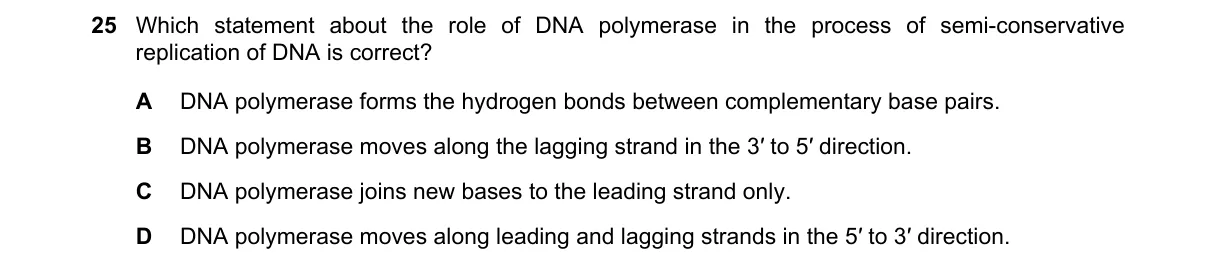
Which statement about the role of DNA polymerase in the process of semi-conservative replication of DNA is correct?
Answer choices
- ADNA polymerase forms the hydrogen bonds between complementary base pairs.
- BDNA polymerase moves along the lagging strand in the 3' to 5' direction.
- CDNA polymerase joins new bases to the leading strand in the 3' to 5' direction.
- DDNA polymerase moves along leading and lagging strands in the 5' to 3' direction.
Explanation
Direction of DNA Polymerase Activity
Steps:
- In semi-conservative replication, each parental strand templates a new strand.
- DNA polymerase adds nucleotides exclusively to the 3' end of the growing chain.
- This results in synthesis of new DNA in the 5' to 3' direction for both leading and lagging strands.
- The leading strand forms continuously, while the lagging strand forms discontinuously via Okazaki fragments, but both follow the same polarity.
Why D is correct:
- DNA polymerase synthesizes DNA by forming phosphodiester bonds in the 5' to 3' direction, as dictated by the enzyme's active site mechanism.
Why the others are wrong:
- A: Hydrogen bonds form via base complementarity during unwinding; DNA polymerase links nucleotides via covalent bonds.
- B: Polymerase moves 5' to 3' relative to the new strand on the lagging template, not 3' to 5'.
- C: New bases are added to the 3' end of the leading strand, synthesizing in the 5' to 3' direction.
Final answer: D
Topic: Structure of nucleic acids and replication of DNA
Practice more A Levels Biology (9700) questions on mMCQ.me