A Levels Biology (9700)•9700/13/M/J/23
A Levels Biology (9700) — 9700/13/M/J/23, Question 20
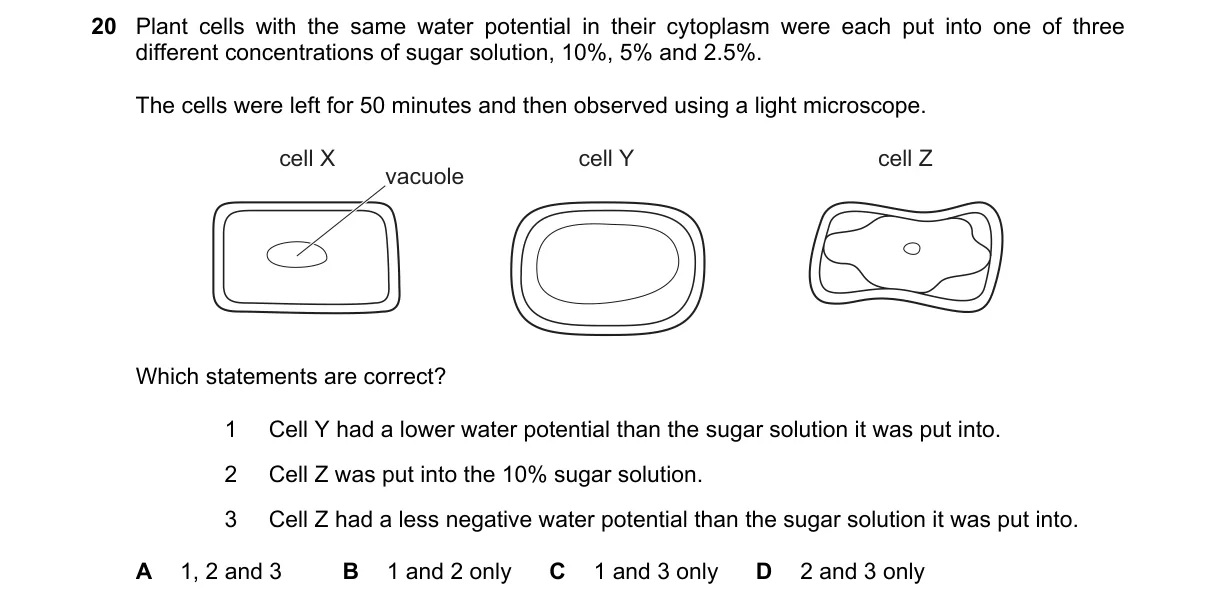
Plant cells with the same water potential in their cytoplasm were each put into one of three concentrations of sugar solution, 10%, 5% and 2.5%. The cells were left for 50 minutes and then observed using a light microscope. [diagrams of cell X, cell Y, cell Z] Which statements are correct?
Answer choices
- A1, 2 and 3
- B1 and 2 only
- C1 and 3 only
- D2 and 3 only
Explanation
Osmosis effects on plant cells in sugar solutions
Steps:
- Cells have identical cytoplasmic water potential; sugar solutions vary in concentration, affecting external water potential.
- In 10% solution (hypertonic), water exits cells, causing plasmolysis (shrunken cytoplasm, cell X).
- In 5% solution (isotonic or near), minimal water movement, cells remain turgid (cell Y).
- In 2.5% solution (hypotonic), water enters cells, increasing turgor pressure (swollen vacuole, cell Z).
- Observations after 50 minutes confirm statements 1 (plasmolysis in X), 2 (turgor in Y), and 3 (increased turgor in Z).
Why A is correct:
- All three statements align with osmosis principle: net water movement equalizes potentials across semi-permeable membranes.
Why the others are wrong:
- B omits statement 3, ignoring hypotonic effects on cell Z.
- C omits statement 2, overlooking balanced conditions for cell Y.
- D omits statement 1, neglecting hypertonic plasmolysis in cell X.
Final answer: A
Topic: Movement into and out of cells
Practice more A Levels Biology (9700) questions on mMCQ.me