A Levels Biology (9700)•9700/13/M/J/23
A Levels Biology (9700) — 9700/13/M/J/23, Question 14
Some animals produce antimicrobial proteins which protect them from pathogens. These proteins could be used to kill human pathogens, however when used as a medicine they are broken down by protein-digesting enzymes. Replacing one of the amino acids found in the protein with an amino acid that had been synthesized in the laboratory resulted in a modified protein that was not broken down by the protein-digesting enzymes. What explains the laboratory result? 1 The modified protein has a different tertiary structure to the original protein. 2 The modified protein is not complementary in shape to the enzyme’s active site. 3 The modified protein is unable to induce a fit with the enzyme’s active site.
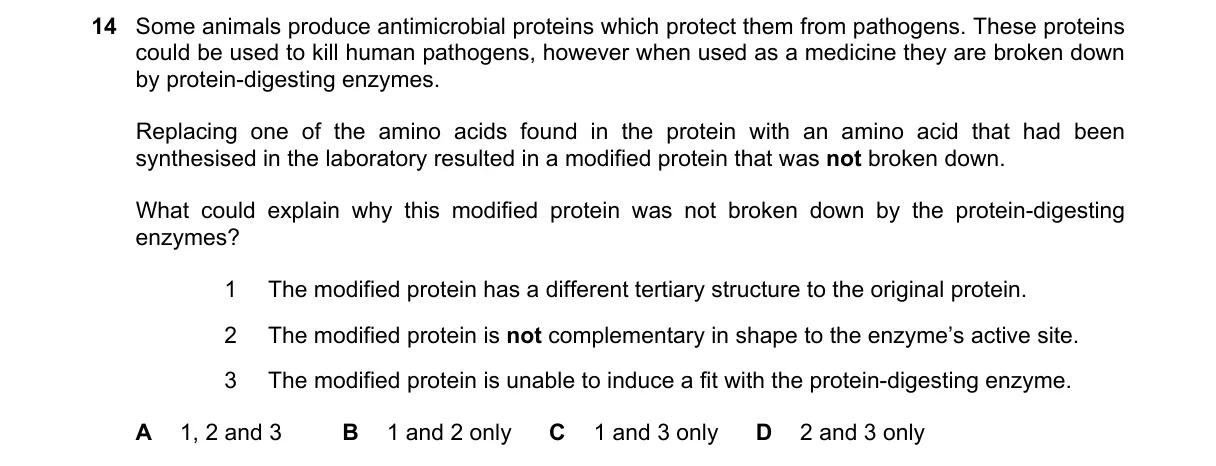
Answer choices
- A1, 2 and 3
- B1 and 2 only
- C1 and 3 only
- D2 and 3 only
Explanation
Protein Modification Alters Enzyme Binding
Steps:
- Replacing one amino acid changes the protein's primary structure.
- This alteration affects folding, resulting in a different tertiary structure (statement 1).
- The new tertiary structure disrupts shape complementarity with the enzyme's active site (statement 2).
- Without complementarity, the protein cannot induce the conformational change needed for enzyme binding (statement 3).
Why A is correct:
- All three statements align with the induced fit model of enzyme-substrate interaction, where structural changes prevent catalysis and degradation.
Why the others are wrong:
- B: Excludes 3, ignoring the role of induced fit in enzyme activation.
- C: Excludes 2, overlooking initial shape matching required for binding.
- D: Excludes 1, neglecting the foundational tertiary structure shift from amino acid substitution.
Final answer: A
Topic: Mode of action of enzymes
Practice more A Levels Biology (9700) questions on mMCQ.me