A Levels Biology (9700)•9700/13/M/J/23
A Levels Biology (9700) — 9700/13/M/J/23, Question 13
The diagram shows three interactions that hold protein molecules in shape. Which row identifies these interactions?
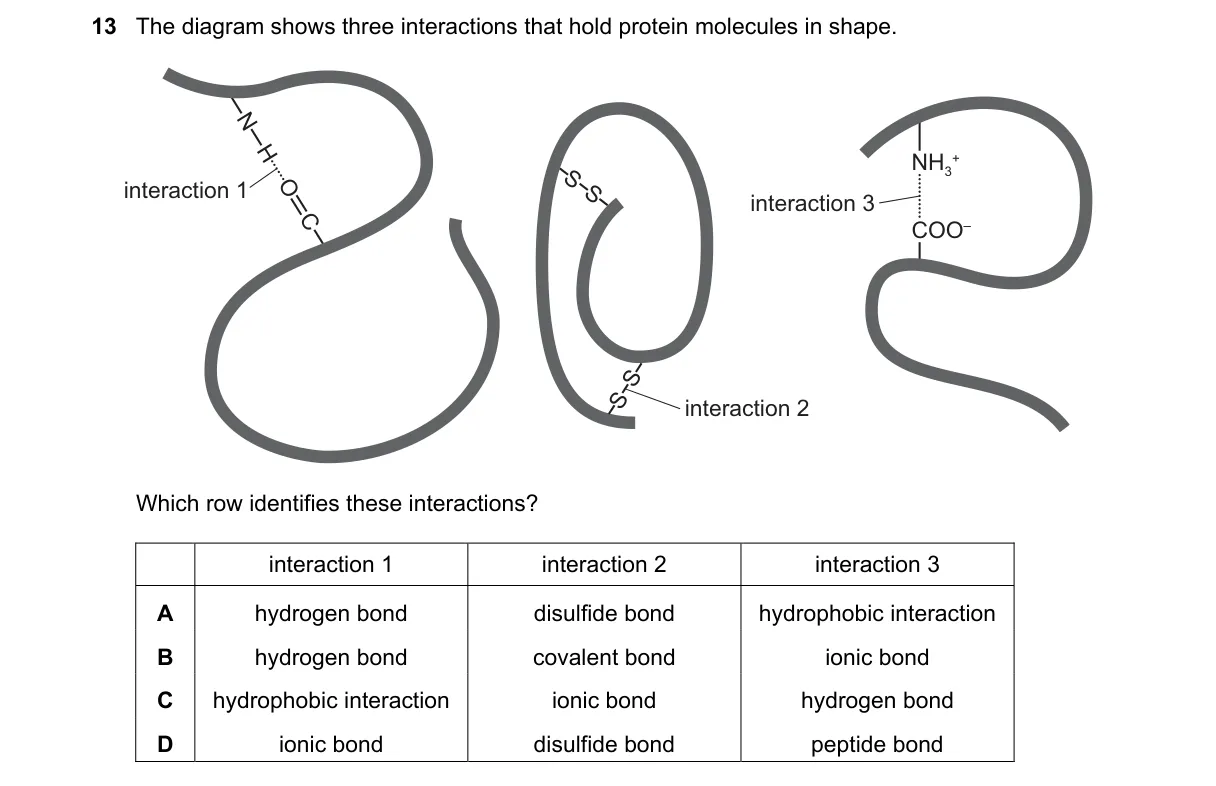
Answer choices
- Ahydrogen bond, disulfide bond, hydrophobic interaction
- Bhydrogen bond, covalent bond, ionic bond
- Chydrophobic interaction, ionic bond, hydrogen bond
- Dhydrophobic interaction, disulfide bond, peptide bond
Explanation
Protein Structure Stabilizing Interactions
Steps:
- Recall that protein tertiary structure is maintained by non-covalent interactions like hydrogen bonds and ionic bonds, plus covalent disulfide bonds.
- Identify that peptide bonds form the primary backbone, not shape maintenance.
- Eliminate options with peptide bonds or mismatched interactions.
- Match the diagram's interactions to hydrogen bonds (between polar groups), covalent bonds (disulfide bridges), and ionic bonds (between charged residues).
Why B is correct:
- Covalent bonds encompass disulfide linkages, which covalently link cysteine residues to stabilize protein folds, as defined in biochemistry for tertiary structure.
Why the others are wrong:
- A: Lists hydrophobic interaction but omits covalent disulfide bonds essential for permanent stabilization.
- C: Reorders interactions but excludes covalent bonds, focusing only on non-covalent forces.
- D: Includes peptide bonds, which create the polypeptide chain but do not maintain 3D shape.
Final answer: B
Topic: Proteins
Practice more A Levels Biology (9700) questions on mMCQ.me