A Levels Biology (9700)•9700/12/M/J/23
A Levels Biology (9700) — 9700/12/M/J/23, Question 7
Which set is the best method for conducting the emulsion test for lipids?
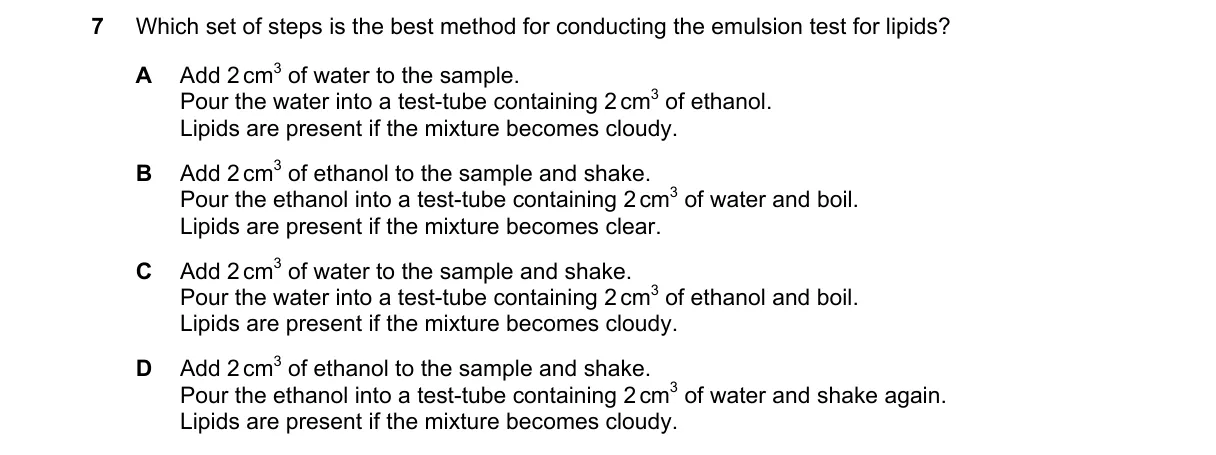
Answer choices
- AAdd 2cm³ of water to the sample and 2cm³ of ethanol. Pour the water into the sample tube and shake. Lipids are present if the mixture becomes cloudy.
- BAdd 2cm³ of ethanol to a test-tube containing 2cm³ of water and boil.
- CPour 2cm³ of water into the test-tube containing 2cm³ of ethanol and shake.
- DPour 2cm³ of ethanol into the test-tube containing 2cm³ of water and shake. Lipids are present if the mixture becomes cloudy.
Explanation
Emulsion Test for Lipids Relies on Ethanol Dissolution and Water Emulsification
Steps:
- Recall standard procedure: Add ethanol to sample to dissolve lipids, then add water and shake for cloudy emulsion.
- Compare choices to this sequence, noting sample is typically in initial tube with water or directly.
- Eliminate options with wrong order, extra steps, or missing cloudiness indicator.
- Select D as it matches adding ethanol to water-based sample tube, followed by shaking for cloudiness.
Why D is correct:
- Lipids are non-polar and soluble in ethanol but insoluble in water; adding ethanol to aqueous sample dissolves them, and shaking emulsifies into cloudy suspension, confirming presence per solubility principles.
Why the others are wrong:
- A: Adds water and ethanol simultaneously to sample without proper dissolution sequence, leading to poor mixing.
- B: Includes unnecessary boiling, which can degrade sample without aiding emulsification.
- C: Reverses addition order (water to ethanol), preventing effective lipid dissolution if sample is in ethanol.
Final answer: D
Topic: Testing for biological molecules
Practice more A Levels Biology (9700) questions on mMCQ.me