A Levels Biology (9700)•9700/12/M/J/23
A Levels Biology (9700) — 9700/12/M/J/23, Question 37
A molecule of oxygen is in the alveolar space next to the wall of the alveolus. The average thicknesses for some structures in the human respiratory system are shown: human cell membrane 5 nm, cytoplasm of alveolar wall cells 90 nm, tissues between alveolar wall and capillary wall 300 nm. What is the shortest distance that a molecule needs to diffuse from its current position to the red blood cell in a capillary? (Assume that the red blood cell touches the blood vessel wall.)
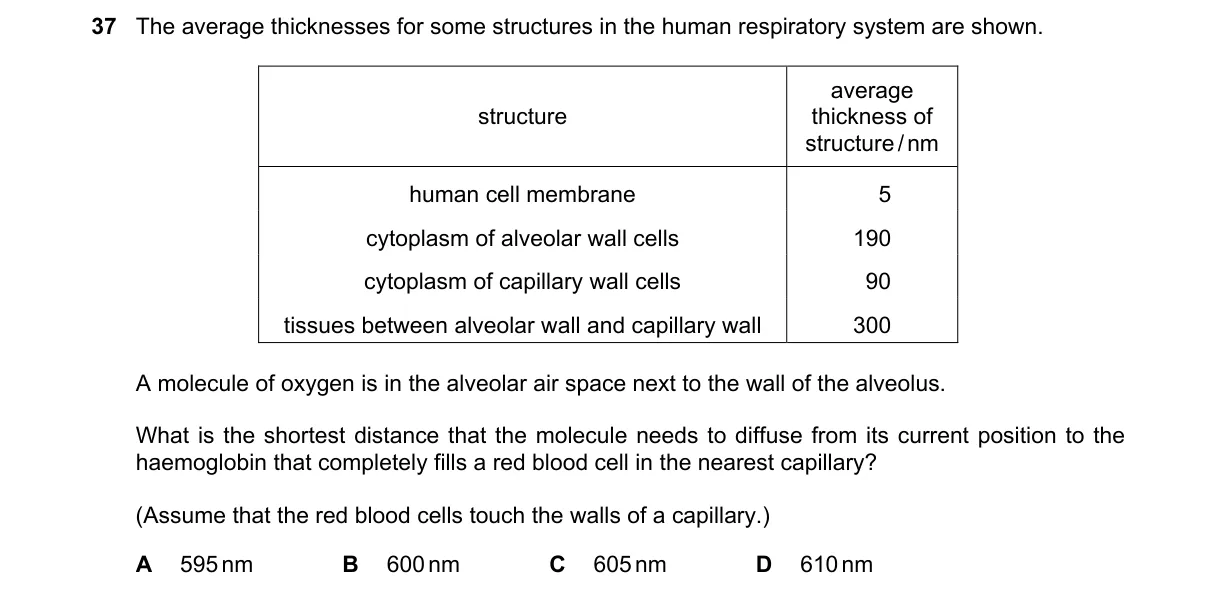
Answer choices
- A595 nm
- B600 nm
- C95 nm
- D610 nm
Explanation
Diffusion across the alveolar wall Steps:
- Molecule starts in alveolar space directly adjacent to the outer cell membrane (distance 0 nm to membrane).
- Diffuses across the human cell membrane: 5 nm.
- Diffuses through the cytoplasm of alveolar wall cells: 90 nm.
- Reaches the inner surface of the alveolar wall, adjacent to the capillary wall touched by the RBC (total distance 95 nm).
Why C is correct:
- The path requires crossing only the alveolar wall's membrane and cytoplasm to reach the RBC, per the given thicknesses and assumption of contact.
Why the others are wrong:
- A: Adds 300 nm tissues to 95 nm (295 nm too low; likely misadds to reach 595 nm).
- B: Rough estimate ignoring precise membrane + cytoplasm sum.
- D: Adds 300 nm tissues plus extra 15 nm (two membranes), inflating the path.
Final answer: C
Topic: The gas exchange system
Practice more A Levels Biology (9700) questions on mMCQ.me