A Levels Biology (9700)•9700/12/M/J/23
A Levels Biology (9700) — 9700/12/M/J/23, Question 30
The photomicrograph shows a transverse section of the leaf of a species of grass. The grass is specially adapted to grow in a habitat. Which row explains how the features help the grass to grow in this habitat?
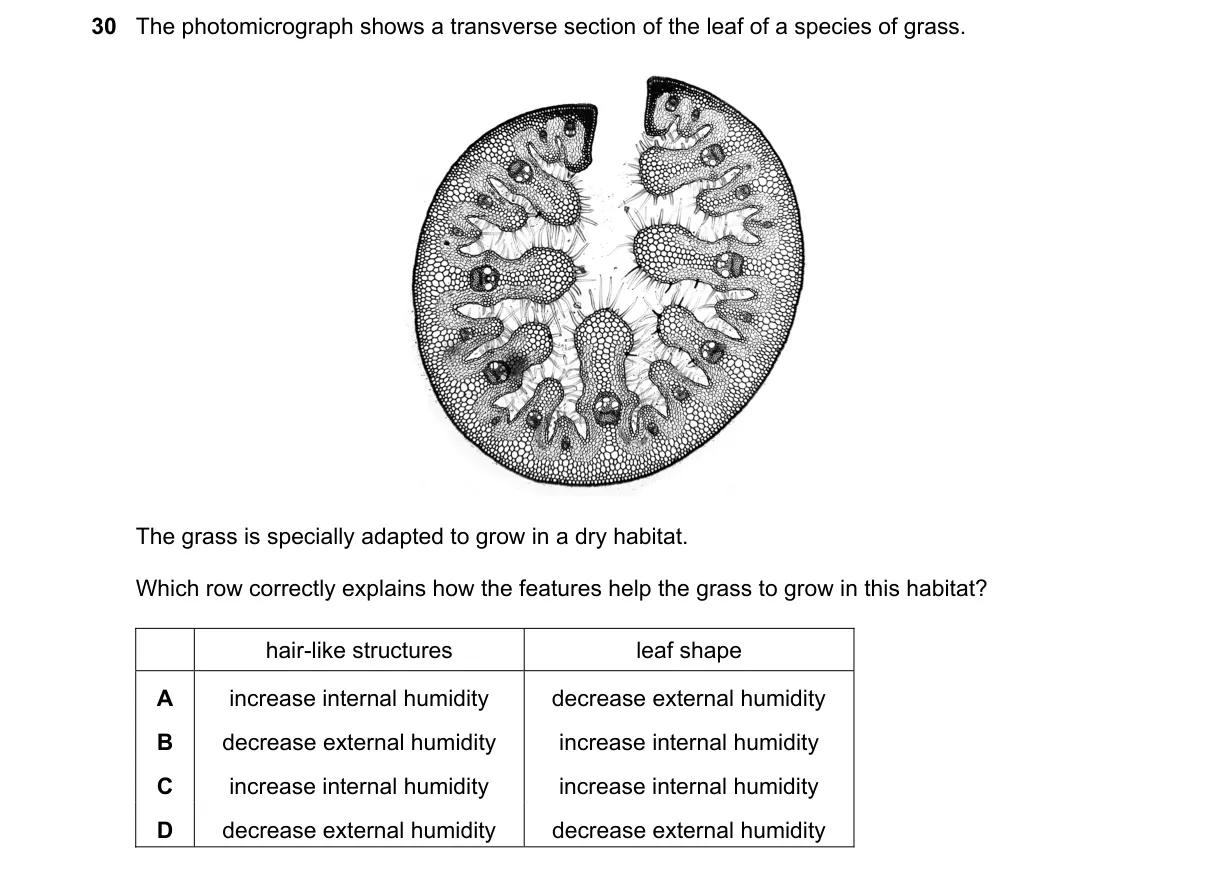
Answer choices
- Ahair-like structures: decrease internal humidity, leaf shape: decrease external humidity
- Bhair-like structures: increase internal humidity, leaf shape: increase internal humidity
- Chair-like structures: increase external humidity, leaf shape: increase internal humidity
- Dhair-like structures: decrease external humidity, leaf shape: decrease external humidity
Explanation
Grass leaf adaptations for water conservation in dry habitats
Steps:
- Examine photomicrograph features: hair-like structures (trichomes) on leaf surface and rolled leaf shape in transverse section.
- Recall trichome function: they trap moist air, increasing external humidity in the boundary layer to reduce transpiration.
- Recall leaf shape function: rolled form minimizes exposed surface area, decreasing water loss and increasing internal humidity.
- Match to option C, which correctly pairs these roles for arid adaptation.
Why C is correct:
- Trichomes increase external humidity by slowing air movement (boundary layer effect), while rolled leaves increase internal humidity by reducing evaporation per Fick's law of diffusion.
Why the others are wrong:
- A: Hairs do not decrease humidity; leaf shape affects internal, not external.
- B: Neither feature primarily increases internal humidity via the described mechanisms.
- D: Features conserve water by increasing, not decreasing, humidities.
Final answer: C
Topic: Homeostasis in plants
Practice more A Levels Biology (9700) questions on mMCQ.me