A Levels Biology (9700)•9700/12/M/J/23
A Levels Biology (9700) — 9700/12/M/J/23, Question 19
An experiment was carried out to investigate the effect of concentration of sucrose solution on plant tissue. A sample of plant tissue was cut into seven cylinders. The mass of each cylinder was measured. Each of the seven cylinders was put into a different sucrose solution concentration. After two hours, the cylinders were removed, blotted and reweighed. The percentage change in mass of each cylinder was calculated. The graph shows the results of this investigation. Which explains the results if plant cells were put into a sucrose solution of 0.4 mol dm⁻³
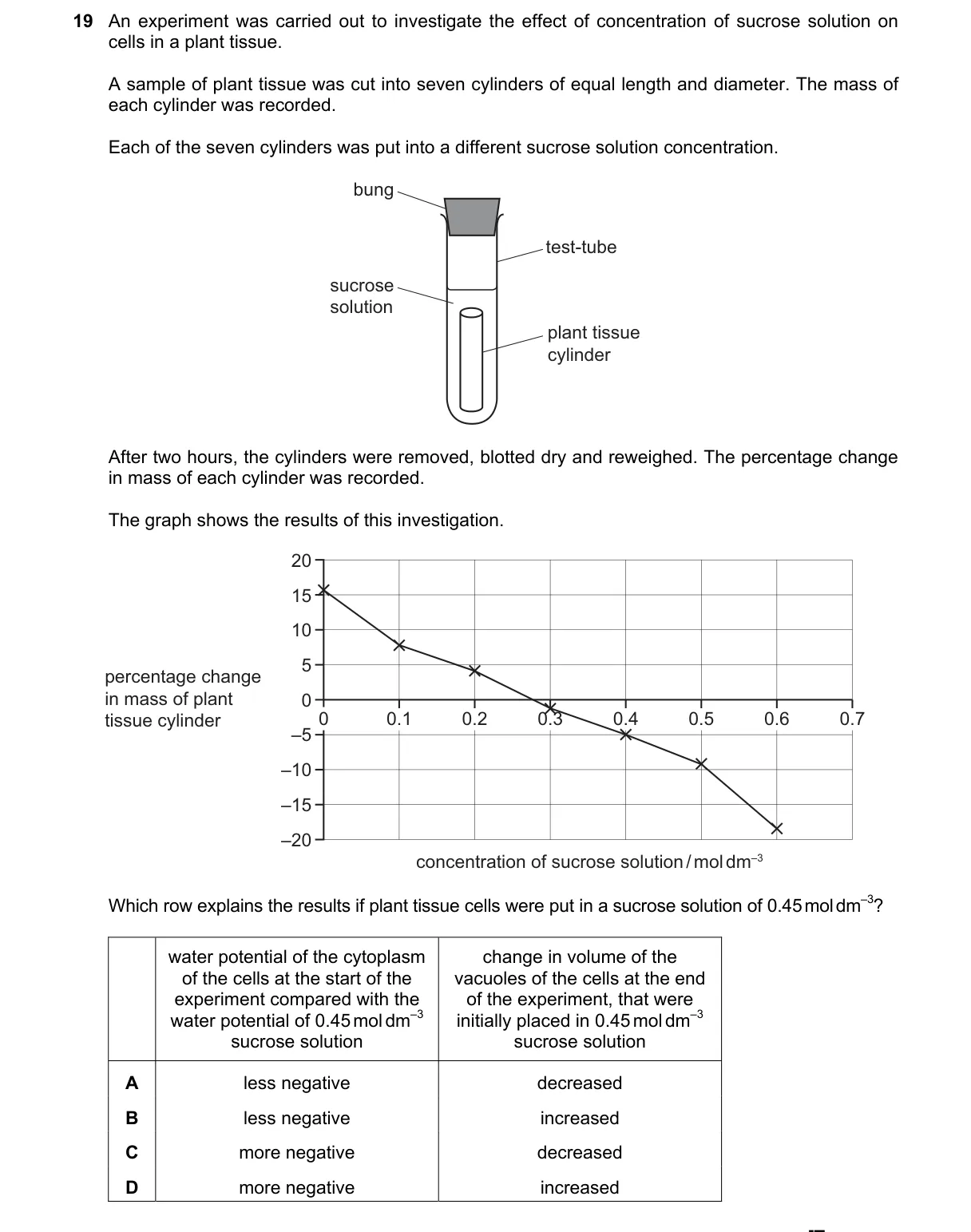
Answer choices
- Awater potential of the cells at the start was less negative than the sucrose solution of 0.4 mol dm⁻³
- Bvacuoles decreased in volume at the end of the experiment
- Cwater potential of the cells at the end was more negative than the sucrose solution of 0.4 mol dm⁻³
- Dvacuoles increased in volume at the end of the experiment
Explanation
Osmosis Driven by Water Potential Gradient
Steps:
- At 0.4 mol dm⁻³ sucrose, the graph shows percentage mass increase, indicating water entry into cells.
- Water moves from higher to lower water potential via osmosis.
- Sucrose solution at 0.4 mol dm⁻³ has lower (more negative) water potential than the initial cell water potential.
- Thus, water enters cells, increasing mass and vacuole volume.
Why A is correct:
- Water potential decreases with solute concentration; initial cell water potential less negative (higher) than 0.4 mol dm⁻³ solution drives water influx per osmosis principle.
Why the others are wrong:
- B: Vacuoles increased, not decreased, due to water entry.
- C: Final cell water potential became less negative (higher) after water gain, not more.
- D: Vacuoles increased in volume from osmosis, but this describes effect, not cause of water potential gradient.
Final answer: A
Topic: Movement into and out of cells
Practice more A Levels Biology (9700) questions on mMCQ.me