A Levels Biology (9700)•9700/11/M/J/23
A Levels Biology (9700) — 9700/11/M/J/23, Question 38
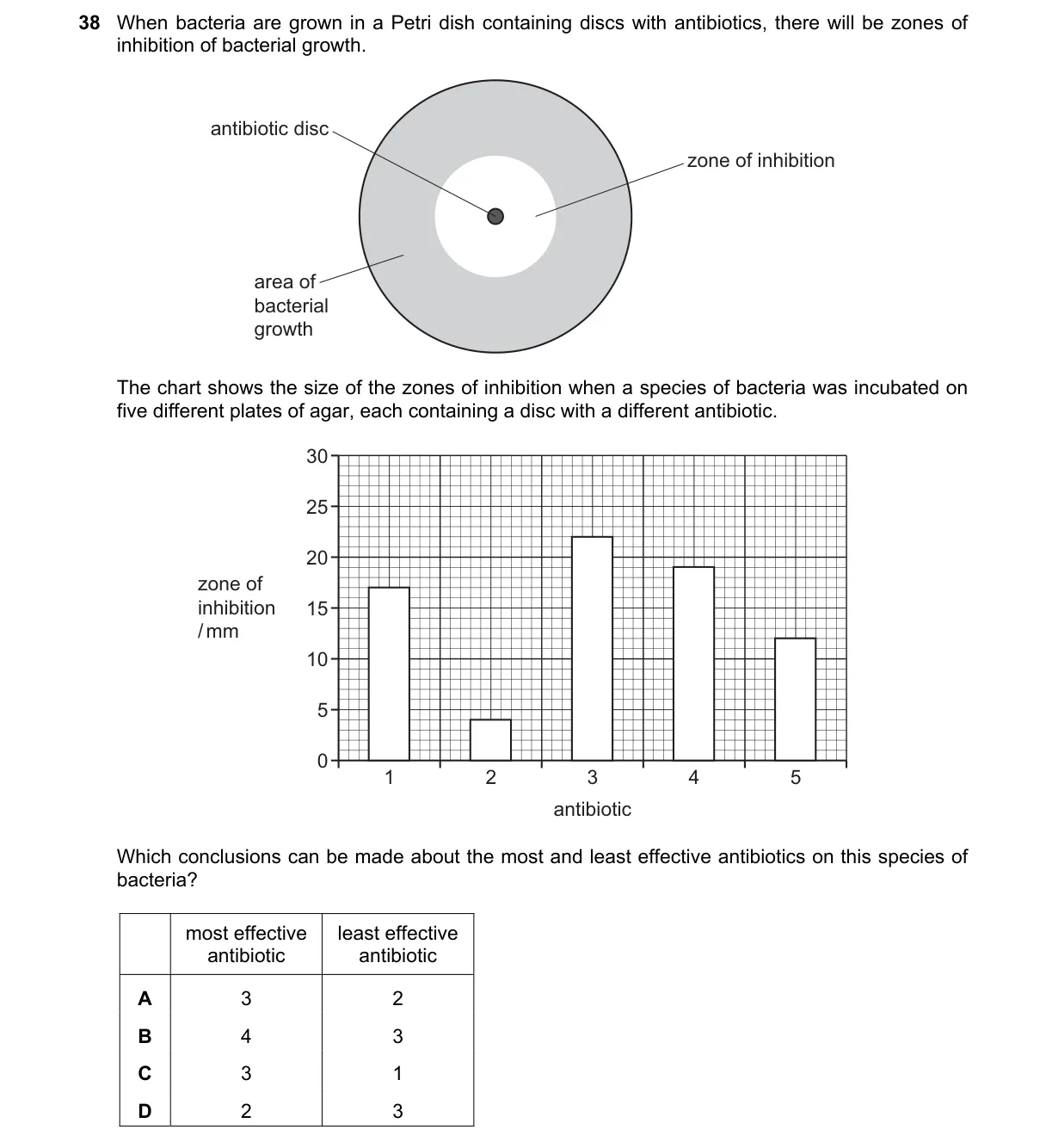
When bacteria are grown in Petri dish containing discs with antibiotics, there will zones of bacterial growth inhibition by the antibiotic disc. When area of bacterial growth inhibition zone. The chart shows the size of the zones of inhibition when a species of bacteria was inoculated on agar, five different plates, each containing disc with a different antibiotic. Which conclusions can be made about the most and least effective antibiotics on this species of bacteria? most effective least effective antibiotic antibiotic
Answer choices
- AOption A
- B3 2
- C4 1
- D2 3
Explanation
Larger inhibition zones mean greater antibiotic effectiveness
Steps:
- Identify zone sizes for each antibiotic from the chart.
- Compare sizes: largest zone indicates most effective antibiotic; smallest indicates least effective.
- Match largest to most effective and smallest to least effective.
- Select option pairing these correctly.
Why A is correct:
- Option A pairs the antibiotic with the largest inhibition zone (most effective) and the one with the smallest (least effective), per the disk diffusion method where zone diameter measures susceptibility.
Why the others are wrong:
- B pairs a medium zone as most effective and another medium as least, ignoring actual size extremes.
- C incorrectly assigns a large zone as least effective, reversing the size-effectiveness relationship.
- D swaps two medium zones, failing to identify true maximum and minimum sizes.
Final answer: A
Topic: Antibiotics
Practice more A Levels Biology (9700) questions on mMCQ.me