A Levels Biology (9700)•9700/11/M/J/23
A Levels Biology (9700) — 9700/11/M/J/23, Question 37
Some of the processes which result in the formation of a population of bacteria that are resistant to a new antibiotic are listed. 1 antibiotic are. 2 increase in frequency of the resistance allele in the population 3 increase in genetic variation within the population 4 increase in genetic variation within the DNA in the population What is the correct order of these processes?
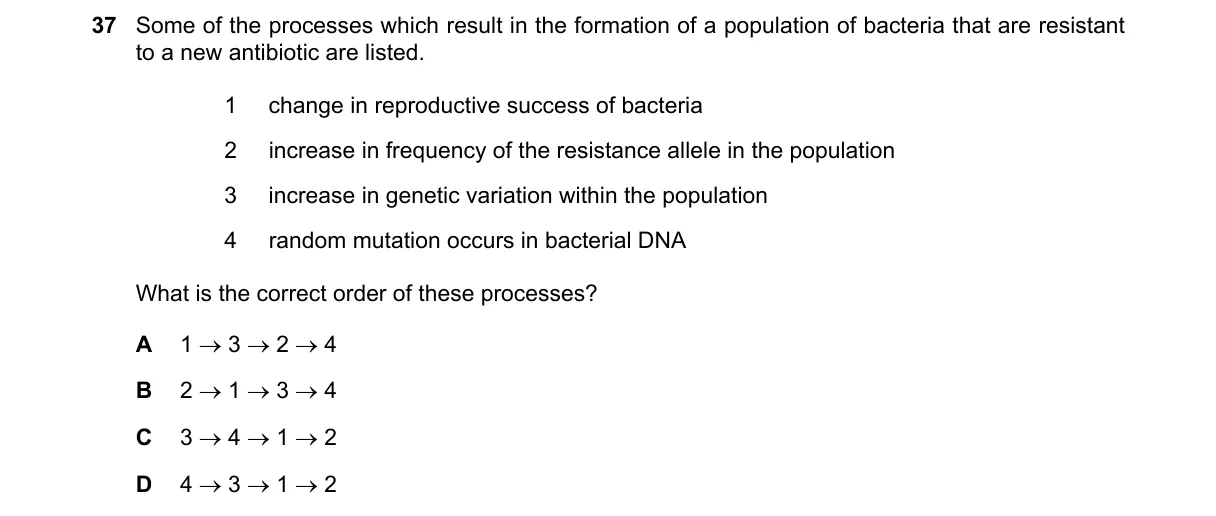
Answer choices
- A2 → 1 → 3 → 4
- B1 → 2 → 3 → 4
- C3 → 4 → 1 → 2
- D4 → 3 → 1 → 2
Explanation
Evolutionary sequence for antibiotic resistance
Steps:
- Mutations in bacterial DNA create new resistance alleles, increasing genetic variation within the DNA (4).
- These mutations spread through reproduction, increasing overall genetic variation in the population (3).
- Introduction of the new antibiotic applies selection pressure, killing non-resistant bacteria (1).
- Surviving resistant bacteria reproduce, increasing the frequency of the resistance allele in the population (2).
Why D is correct:
- It matches the Darwinian process: mutation generates variation (4→3), selection via antibiotic acts (1), then allele frequency rises (2).
Why the others are wrong:
- A: Begins with allele frequency increase (2), impossible without prior variation and selection.
- B: Starts with antibiotic introduction (1), but resistance alleles must pre-exist via mutation.
- C: Places population variation (3) before DNA variation (4), reversing the mutation source.
Final answer: D
Topic: Natural and artificial selection
Practice more A Levels Biology (9700) questions on mMCQ.me