A Levels Biology (9700)•9700/11/M/J/23
A Levels Biology (9700) — 9700/11/M/J/23, Question 27
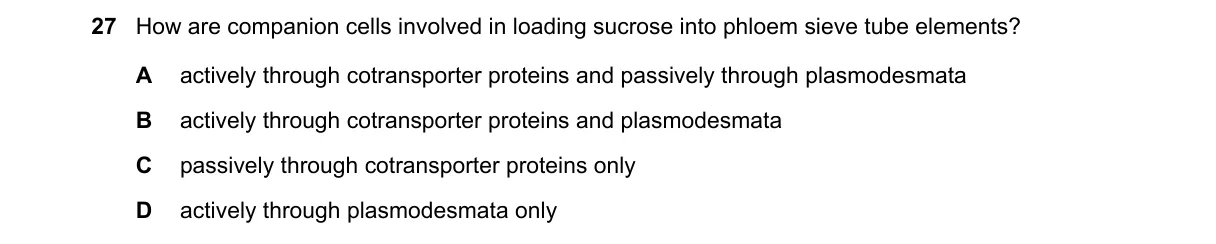
How are companion cells involved in loading sucrose into phloem tube elements?
Answer choices
- Aactively through cotransporter proteins and passively through plasmodesmata
- Bactively through cotransporter proteins and plasmodesmata
- Cpassively through cotransporter proteins only
- Dactively through plasmodesmata only
Explanation
Phloem Sucrose Loading by Companion Cells
Steps:
- Companion cells actively uptake sucrose from the apoplast using proton-sucrose cotransporter proteins, powered by a proton gradient.
- This active transport concentrates sucrose inside companion cells against its gradient.
- Sucrose then moves passively from companion cells into sieve tube elements through connecting plasmodesmata.
- The process establishes osmotic pressure for phloem sap flow.
Why A is correct:
- Active loading via cotransporter proteins uses H+-sucrose symporters to harness electrochemical gradients, while plasmodesmata permit passive diffusion, defining the symplast-apoplast pathway in plant physiology.
Why the others are wrong:
- B: Plasmodesmata enable passive symplastic movement, not active transport.
- C: Cotransporter proteins drive active transport, not passive.
- D: Plasmodesmata support passive flow only, without active mechanisms.
Final answer: A
Topic: Transport mechanisms
Practice more A Levels Biology (9700) questions on mMCQ.me