A Levels Biology (9700)•9700/11/M/J/23
A Levels Biology (9700) — 9700/11/M/J/23, Question 15
Four students, A, B, C and D observed plant epidermal cells that had been placed in a concentrated sucrose solution for 30 minutes. They were asked to explain the appearance of the cells in terms of water potential and movement of water. Which student is correct?
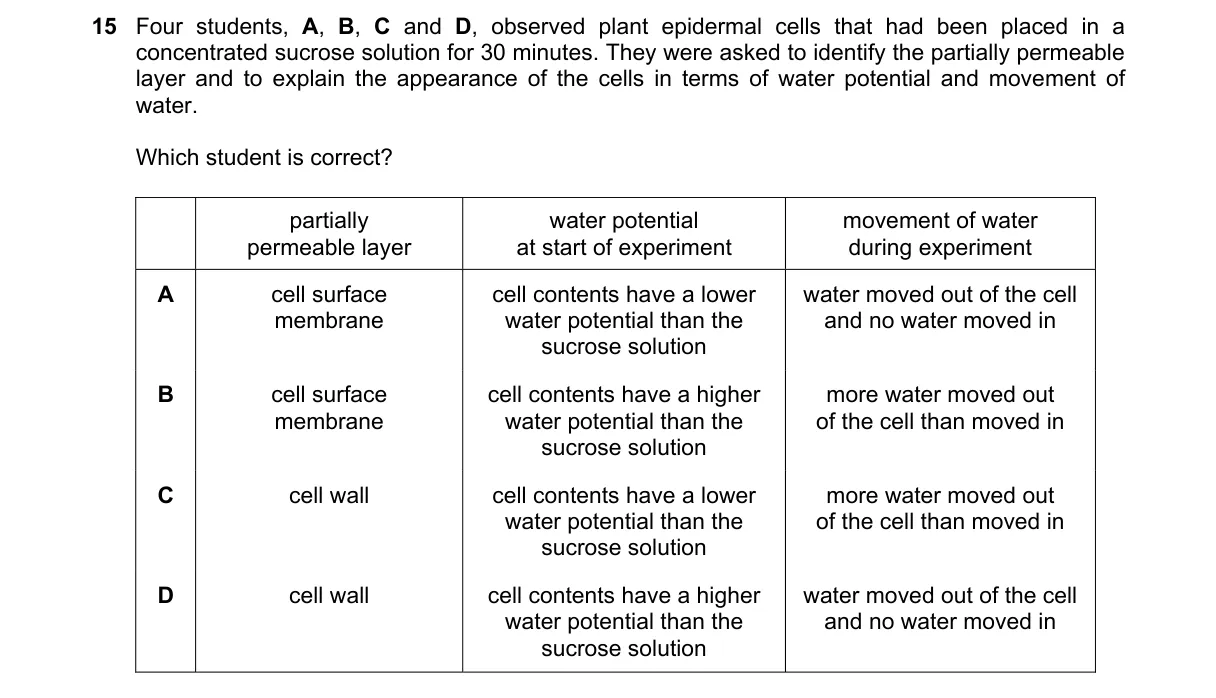
Answer choices
- Acell surface; cell contents have a lower water potential than the solution; water moved out of the cell
- Bcell surface; cell contents have higher water potential than the solution; more water moved out of the cell
- Cmembrane wall; cell contents have a lower water potential than the sucrose solution; more water moved out of the cell than in
- Dcell wall; cell contents have a lower water potential than the sucrose solution; no water moved out of the cell
Explanation
Osmosis driven by water potential gradient in hypertonic solution
Steps:
- Concentrated sucrose solution has low water potential due to high solute concentration.
- Plant cell contents initially have higher water potential than the external solution.
- Water moves from high to low water potential, exiting the cell via osmosis.
- This causes cells to appear shrunken as water loss exceeds gain.
Why B is correct:
- Water potential gradient dictates osmosis: water flows from higher ψ (cell contents) to lower ψ (solution), resulting in net water outflow.
Why the others are wrong:
- A: Cell contents have higher, not lower, water potential than solution.
- C: "Membrane wall" is incorrect term; cell wall is non-permeable to water.
- D: Water does move out due to potential difference; no net movement is false.
Final answer: B
Topic: Movement into and out of cells
Practice more A Levels Biology (9700) questions on mMCQ.me