A Levels Biology (9700)•9700/13/M/J/22
A Levels Biology (9700) — 9700/13/M/J/22, Question 9
Trehalose is a sugar that gives a negative result when tested with Benedict's solution. A molecule of trehalose forms two glucose molecules when it is hydrolysed. Which row is correct?
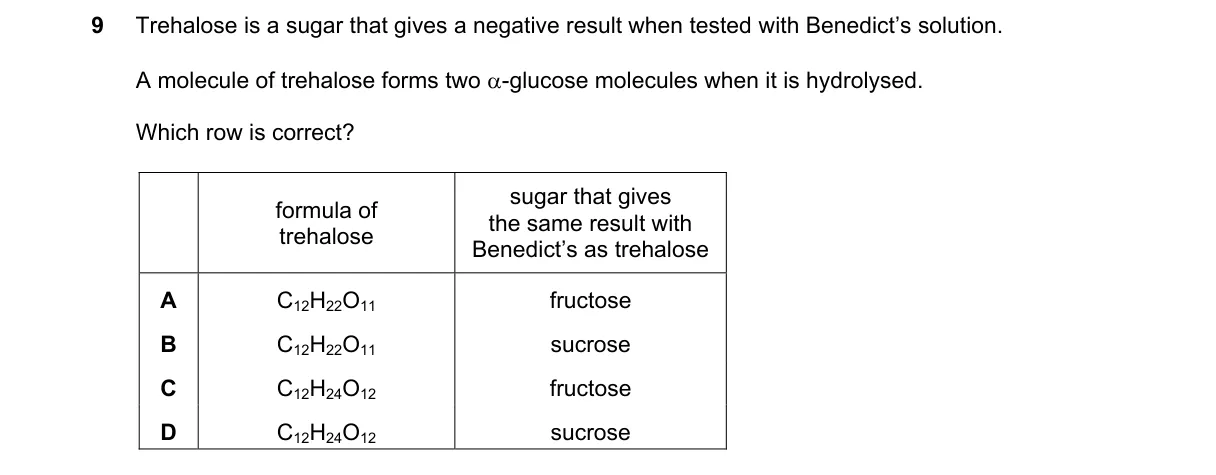
Answer choices
- AC12H22O11 fructose
- BC12H22O11 sucrose
- CC6H12O6 fructose
- DC6H12O6 sucrose
Explanation
Trehalose as a non-reducing disaccharide Steps:
- Trehalose gives negative Benedict's test, indicating a non-reducing sugar.
- Hydrolysis yields two glucose molecules, confirming it as a disaccharide.
- Disaccharides have formula C12H22O11, matching two C6H12O6 units minus water.
- Compare choices: select matching formula and disaccharide type (non-reducing like sucrose).
Why B is correct:
- C12H22O11 is the formula for non-reducing disaccharides like sucrose; trehalose shares this structure and properties.
Why the others are wrong:
- A: Fructose is a monosaccharide (C6H12O6), reducing and not matching disaccharide formula.
- C: C6H12O6 is monosaccharide formula; trehalose is a disaccharide.
- D: Sucrose name with C6H12O6 formula mismatches; sucrose is C12H22O11.
Final answer: B
Topic: Testing for biological molecules
Practice more A Levels Biology (9700) questions on mMCQ.me