A Levels Biology (9700)•9700/13/M/J/22
A Levels Biology (9700) — 9700/13/M/J/22, Question 5
Which row shows a comparison that is not correct between a typical prokaryotic cell and a typical eukaryotic plant cell?
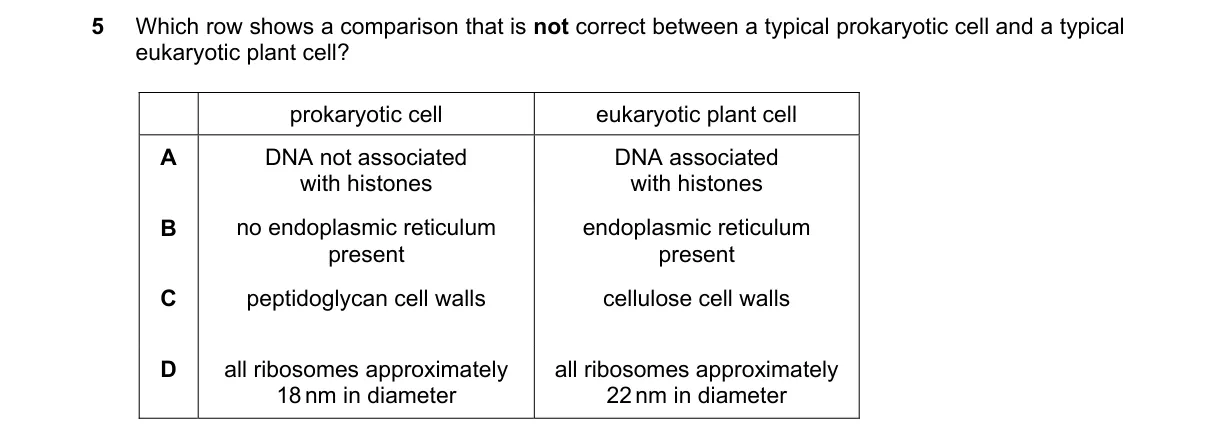
Answer choices
- Aprokaryotic cell: DNA with histones; eukaryotic plant cell: DNA associated with histones
- Bprokaryotic cell: no endoplasmic reticulum; eukaryotic plant cell: present endoplasmic reticulum
- Cprokaryotic cell: peptidoglycan cell walls; eukaryotic plant cell: cellulose cell walls
- Dprokaryotic cell: all ribosomes approximately 18 nm in diameter; eukaryotic plant cell: all ribosomes approximately 22 nm in diameter
Explanation
Incorrect Ribosome Uniformity in Plant Cells Steps:
- Evaluate DNA packaging: prokaryotes use histone-like proteins, eukaryotes use true histones—both organize DNA.
- Assess organelle presence: prokaryotes lack ER, while eukaryotic plant cells have rough and smooth ER.
- Compare cell walls: prokaryotes use peptidoglycan for rigidity, plant cells use cellulose for structure.
- Examine ribosomes: prokaryotes have uniform 70S (~18-20 nm), but plant cells have mixed 80S (~25 nm) and 70S (~20 nm) types.
Why D is correct:
- Eukaryotic plant cells have 70S ribosomes in mitochondria and chloroplasts plus 80S in cytosol, violating the "all approximately 22 nm" claim per organelle definition.
Why the others are wrong:
- A: Prokaryotic DNA associates with histone-like proteins (e.g., HU), similar to eukaryotic histone association.
- B: Prokaryotes lack endoplasmic reticulum as they have no membrane-bound organelles.
- C: Prokaryotic walls contain peptidoglycan; plant eukaryotic walls contain cellulose.
Final answer: D
Topic: Cells as the basic units of living organisms
Practice more A Levels Biology (9700) questions on mMCQ.me