A Levels Biology (9700)•9700/13/M/J/22
A Levels Biology (9700) — 9700/13/M/J/22, Question 40
Some of the events during the primary immune response are listed. 1 phagocytosis of a foreign microbe by a macrophage and antigen presentation 2 some T-lymphocytes will become T-killer cells which infect body cells 3 the T-helper cell divides by mitosis to produce T-lymphocyte clone cells 4 a T-helper cell with complementary receptor binds to the antigens being What is the correct sequence of events during the primary immune response?
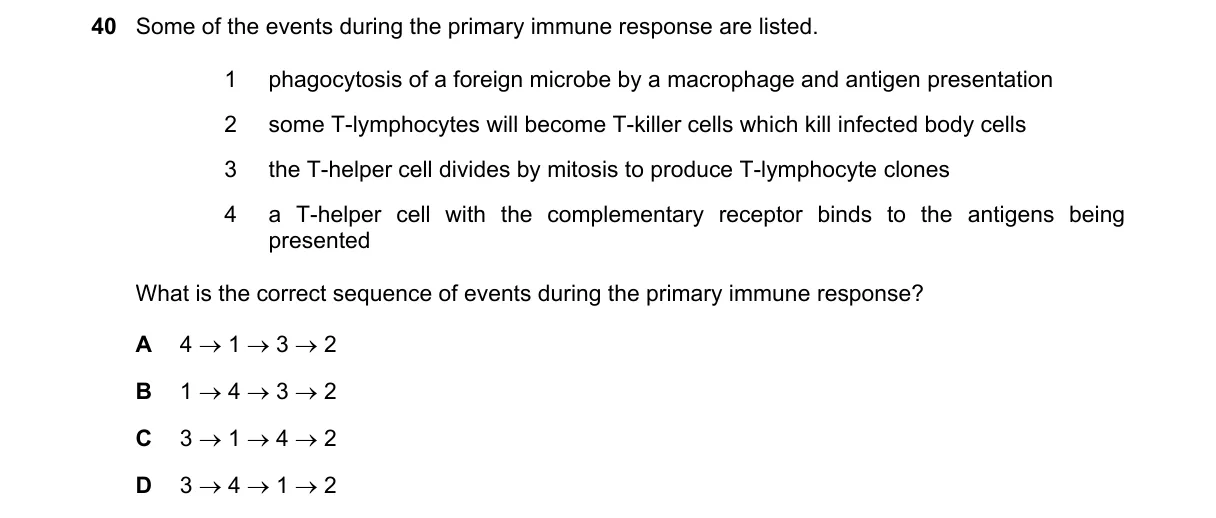
Answer choices
- A1 → 3 → 4 → 2
- B4 → 1 → 3 → 2
- C3 → 1 → 4 → 2
- D3 → 4 → 1 → 2
Explanation
Sequence of Events in Primary Immune Response
Steps:
- T-helper cell binds antigen via complementary receptor (4), starting recognition.
- Macrophage phagocytoses microbe and presents antigen (1), confirming and processing the signal.
- T-helper divides by mitosis into clones (3), expanding the response.
- Clones differentiate into T-killer cells targeting infected cells (2), executing defense.
Why B is correct:
- Matches the immunological sequence where T-cell binding initiates activation before full phagocytosis and clonal expansion, per adaptive immunity principles.
Why the others are wrong:
- A: Places division (3) before binding (4), skipping activation step.
- C: Begins with unstimulated division (3), violating cell cycle rules.
- D: Starts with division (3) and ends with presentation (1), inverting antigen processing order.
Final answer: B
Topic: The immune system
Practice more A Levels Biology (9700) questions on mMCQ.me