A Levels Biology (9700)•9700/13/M/J/22
A Levels Biology (9700) — 9700/13/M/J/22, Question 39
A person's blood group is determined by antigens present on red blood cells. Antibodies in the plasma of person who receives blood can make some transfusions unsafe. The table shows the antigens and antibodies in the blood groups. Blood group A: Presence of A or B antigens on red cells - A only; Presence of antibodies in plasma - Anti-B only. Blood group B: Presence of A or B antigens on red cells - B only; Presence of antibodies in plasma - Anti-A only. Blood group AB: Presence of A or B antigens on red cells - A and B; Presence of antibodies in plasma - Neither. Blood group O: Presence of A or B antigens on red cells - Neither; Presence of antibodies in plasma - Anti-A and anti-B. Which blood group can give blood to a person with group A?
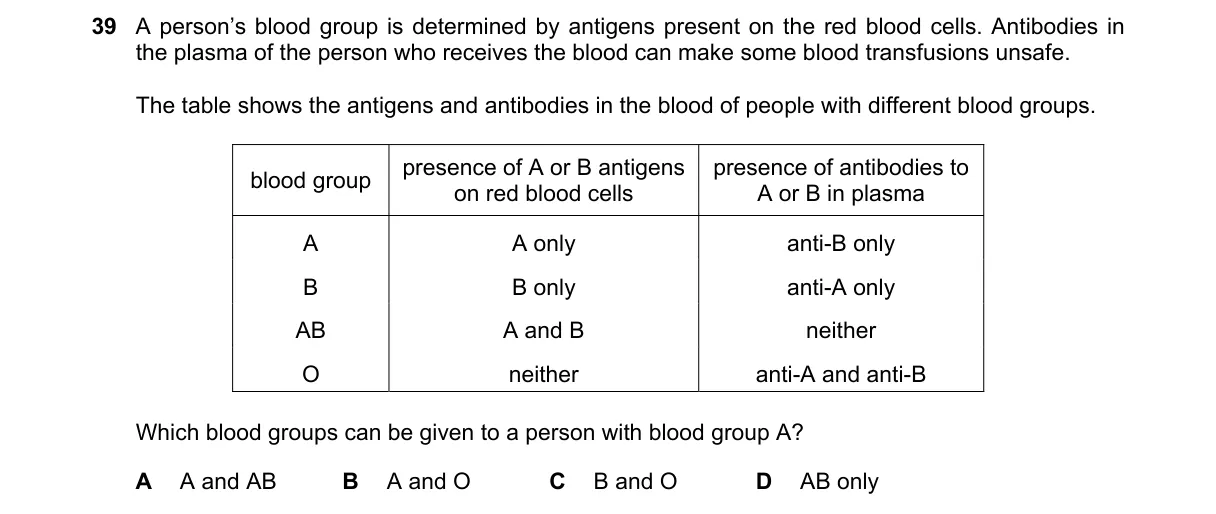
Answer choices
- AA and AB
- BA and O
- CB and O
- DAB only
Explanation
Blood Compatibility for Group A Recipients
Steps:
- Recipient A has anti-B antibodies, so donor RBCs must lack B antigens to avoid agglutination.
- Group A donor has only A antigens, no B, so safe.
- Group O donor has no A or B antigens, universally compatible as donor.
- Group B has B antigens, incompatible.
- Group AB has B antigens, incompatible.
Why B is correct:
- Groups A and O both lack B antigens, preventing reaction with recipient A's anti-B antibodies per ABO compatibility rules.
Why the others are wrong:
- A: AB has B antigens, triggering anti-B attack.
- C: B has B antigens, directly attacked by anti-B.
- D: Omits group A, which is fully compatible.
Final answer: B
Topic: The immune system
Practice more A Levels Biology (9700) questions on mMCQ.me