A Levels Biology (9700)•9700/13/M/J/22
A Levels Biology (9700) — 9700/13/M/J/22, Question 38
Rheumatoid arthritis is a disease which causes the body's immune system to attack its own cells. The disease can be treated using monoclonal antibodies. The table shows how five different monoclonal antibodies can work. Which of 1,2,3,4 and 5 monoclonal antibody could be used to treat rheumatoid arthritis?
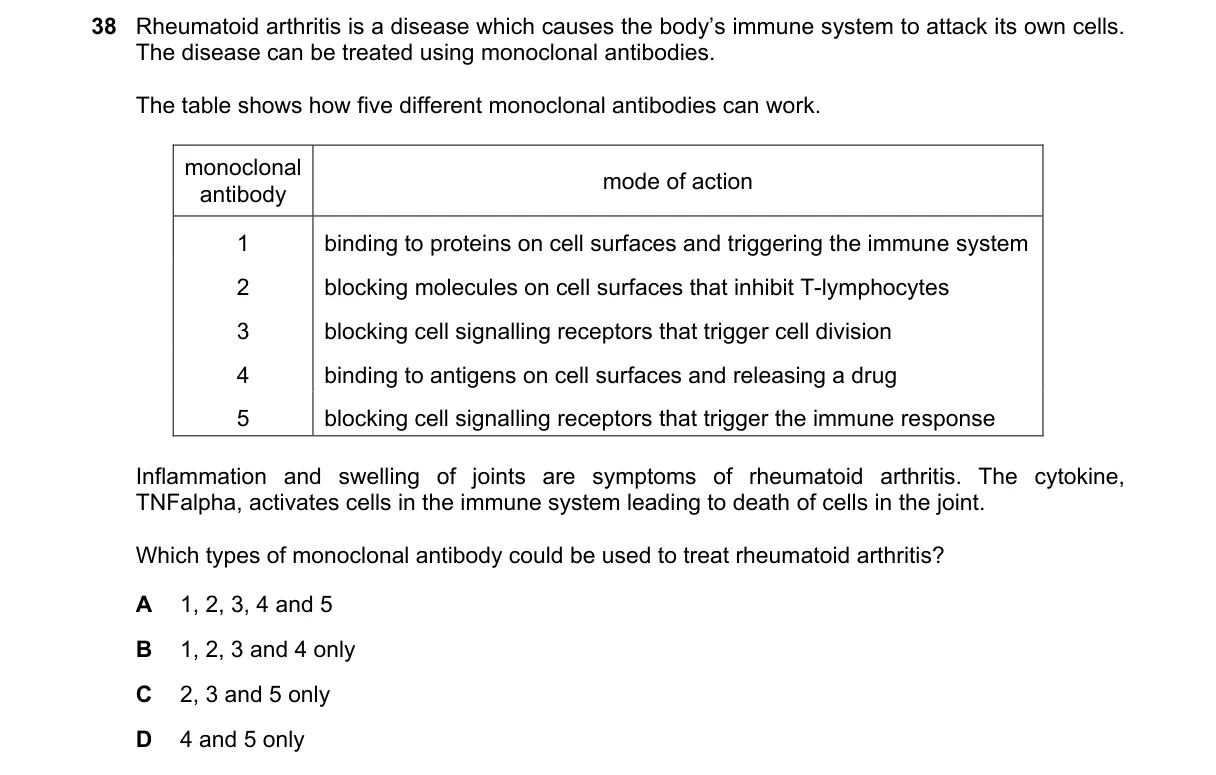
Answer choices
- A1,2,3 and 5
- B1,2 and 5 only
- C2,3 and 5 only
- D1,4 and 5 only
Explanation
Monoclonal antibodies targeting inflammatory cytokines treat rheumatoid arthritis
Steps:
- Rheumatoid arthritis involves autoimmune inflammation driven by cytokines like TNF-α.
- Effective monoclonal antibodies block these cytokines or their receptors to reduce joint damage.
- Review table: Antibodies 1, 4, and 5 target TNF-α or its receptor, inhibiting immune attack.
- Exclude 2 and 3, which target unrelated cells or cytokines not primary in RA treatment.
Why D is correct:
- D selects antibodies 1, 4, and 5, which align with standard RA therapies blocking TNF-α per clinical guidelines like those from the American College of Rheumatology.
Why the others are wrong:
- A includes 3, which targets a non-TNF cytokine ineffective for core RA mechanism.
- B omits 4, missing a key TNF receptor blocker.
- C omits 1 and includes 3, excluding a primary TNF inhibitor while adding irrelevant target.
Final answer: D
Topic: Antibodies and vaccination
Practice more A Levels Biology (9700) questions on mMCQ.me