A Levels Biology (9700)•9700/13/M/J/22
A Levels Biology (9700) — 9700/13/M/J/22, Question 29
Which processes occur during loading of sucrose into phloem tubes 1 Proteins are pumped out of the cytoplasm of phloem sieve tubes into cell wall. 2 There is a higher concentration of protons in the symplast pathway outside the 3 Proteins are unable to move back into companion cell. 4 A proton-sucrose co-transporter acts as an entry point for sucrose.
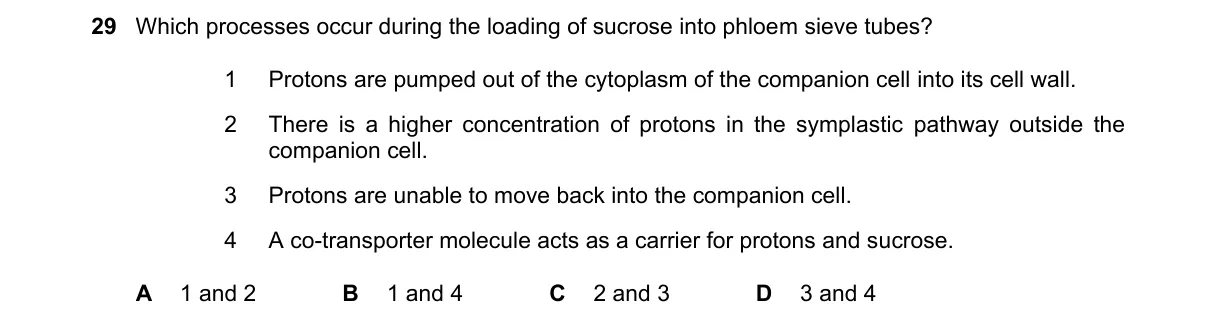
Answer choices
- A1 and 2
- B1 and 4
- C2 and 3
- D3 and 4
Explanation
Proton-driven active loading of sucrose into phloem
Steps:
- H+-ATPase pumps protons out of companion cell cytoplasm into the apoplast (cell wall), matching statement 1.
- This establishes a proton gradient with higher concentration in the apoplast, not symplast, so statement 2 is inaccurate.
- The plasma membrane is largely impermeable to protons, preventing easy back-diffusion, but statement 3 overstates as "unable" ignores minor leaks.
- Sucrose enters companion cells via proton-sucrose symporter using the gradient, confirming statement 4.
Why B is correct:
- Statements 1 and 4 describe the core mechanism: proton pumping creates the electrochemical gradient for symport-driven sucrose uptake, per the chemiosmotic theory in plant transport.
Why the others are wrong:
- A includes 2, which misplaces high proton concentration in symplast instead of apoplast.
- C includes 2 (incorrect) and 3 (incomplete, as proton impermeability supports but does not fully define loading).
- D includes 3, which is not a primary process in sucrose loading.
Final answer: B
Topic: Transport mechanisms
Practice more A Levels Biology (9700) questions on mMCQ.me