A Levels Biology (9700)•9700/13/M/J/22
A Levels Biology (9700) — 9700/13/M/J/22, Question 22
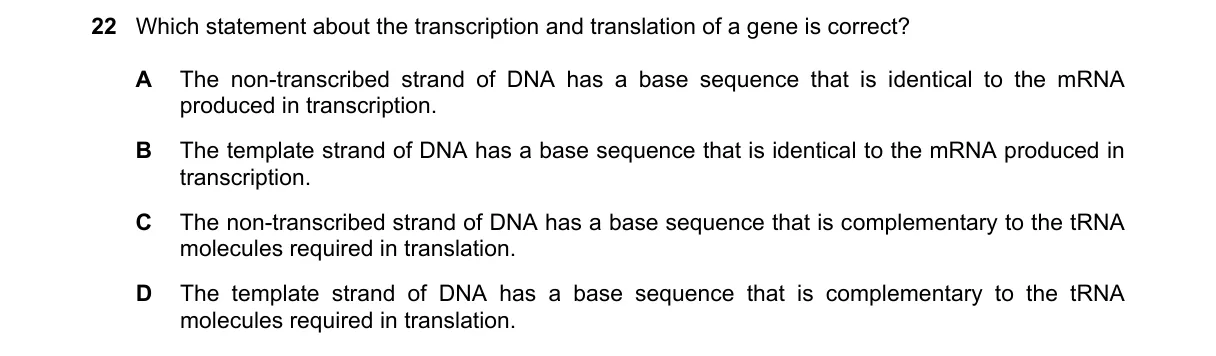
Which statement about the transcription and translation of a gene is correct?
Answer choices
- AThe non-transcribed strand of DNA has a base sequence that is identical to the mRNA
- BThe template strand of DNA has a base sequence that is identical to the mRNA produced in transcription.
- CThe non-template strand of DNA has a base sequence that is complementary to the mRNA
- DThe template strand of DNA has a base sequence that is complementary to the mRNA molecules required in translation.
Explanation
DNA Strands in Transcription Steps:
- Identify the template strand as the one read by RNA polymerase during transcription to produce complementary mRNA.
- Note that mRNA base pairs with the template: A-U, T-A, G-C, C-G (DNA T becomes A in mRNA, etc.).
- Recognize the non-template strand has the same sequence as mRNA, except T in DNA vs. U in RNA.
- Compare each option to these base-pairing rules and sequence matches.
Why D is correct:
- By base-pairing rules in transcription, the template strand's sequence is complementary to the mRNA, which is then used in translation.
Why the others are wrong:
- A: Non-transcribed (non-template) strand matches mRNA sequence but is not identical due to T in DNA vs. U in RNA.
- B: Template strand is complementary to mRNA, not identical.
- C: Non-template strand matches mRNA sequence, not complementary to it.
Final answer: D
Topic: Protein synthesis
Practice more A Levels Biology (9700) questions on mMCQ.me