A Levels Biology (9700)•9700/13/M/J/22
A Levels Biology (9700) — 9700/13/M/J/22, Question 14
Batrachotoxin is a poison found in frogs in the Colombian jungle. The poison is used to produce darts. The poison works by increasing the permeability of the cell surface membrane of nerve and muscle cells to sodium ions, which move out of the cells. Four students made statements about how the poison affects the cells. 1 Water leaves the cells by osmosis, causing the cells to shrink. 2 When sodium ions move out of the cells, the intracellular fluid has a more 3 When sodium ions move out of the cells, the extracellular fluid has a more 4 When the sodium ions move out of the cells, the extracellular fluid has a more Which statements are correct for the cells affected by batrachotoxin?
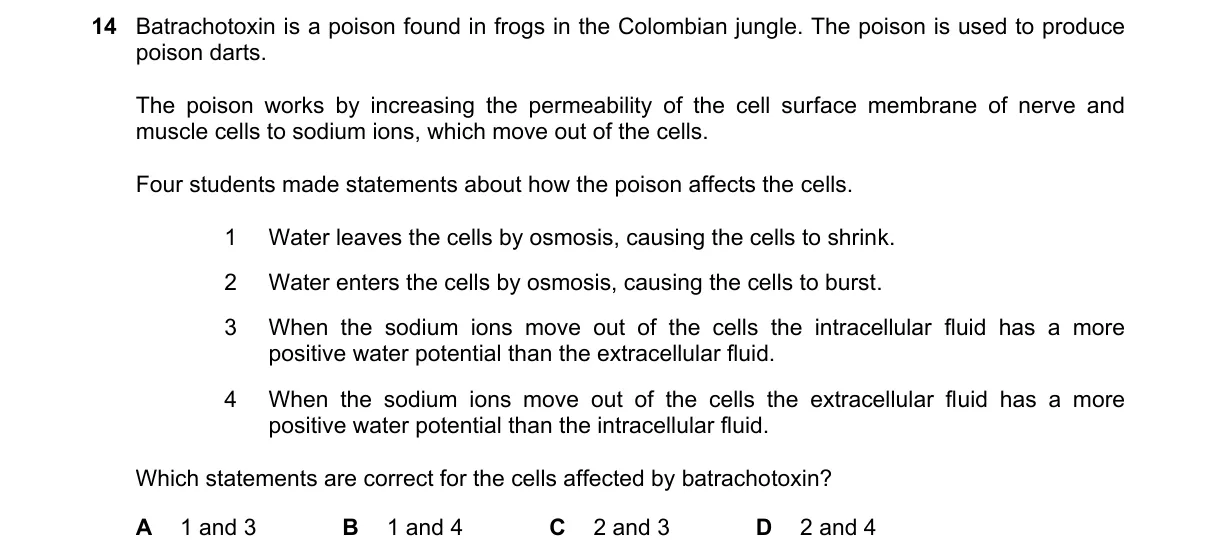
Answer choices
- A1 and 3
- B1 and 4
- C2 and 3
- D2 and 4
Explanation
Sodium Efflux and Osmotic Effects Steps:
- Batrachotoxin increases cell membrane permeability to Na⁺, allowing Na⁺ to exit cells as stated.
- Na⁺ efflux reduces intracellular solute concentration, making the intracellular fluid hypotonic.
- Osmosis then draws water out of the cell to the hypertonic extracellular space, shrinking the cell (statement 1 correct).
- Extracellular space gains Na⁺, increasing its solute concentration (statement 3 correct; statements 2 and 4 likely claim opposite concentration changes, which are incorrect).
Why A is correct:
- Na⁺ efflux lowers intracellular osmolarity (causing water loss and shrinkage, per statement 1) and raises extracellular osmolarity (per statement 3), following osmotic principles where water moves toward higher solute concentration.
Why the others are wrong:
- B: Statement 4 wrongly implies extracellular fluid becomes less concentrated; Na⁺ influx there increases concentration.
- C: Statement 2 wrongly suggests intracellular fluid becomes more concentrated; it becomes less concentrated.
- D: Statements 2 and 4 both misstate concentration changes from Na⁺ efflux.
Final answer: A
Topic: Movement into and out of cells
Practice more A Levels Biology (9700) questions on mMCQ.me