A Levels Biology (9700)•9700/12/M/J/22
A Levels Biology (9700) — 9700/12/M/J/22, Question 40
A student used a diagram to show four types of cells involved in the primary immune response. unknown antigen enters the body. cell type 3 produces cell type 1 required to bind to the antigen. cell type 2 destroys cells infected with viruses which would be released into the body. cell type 4 recognizes the foreign antigen and surrounds it. releases chemicals that engulf antigens. Which row is correct?
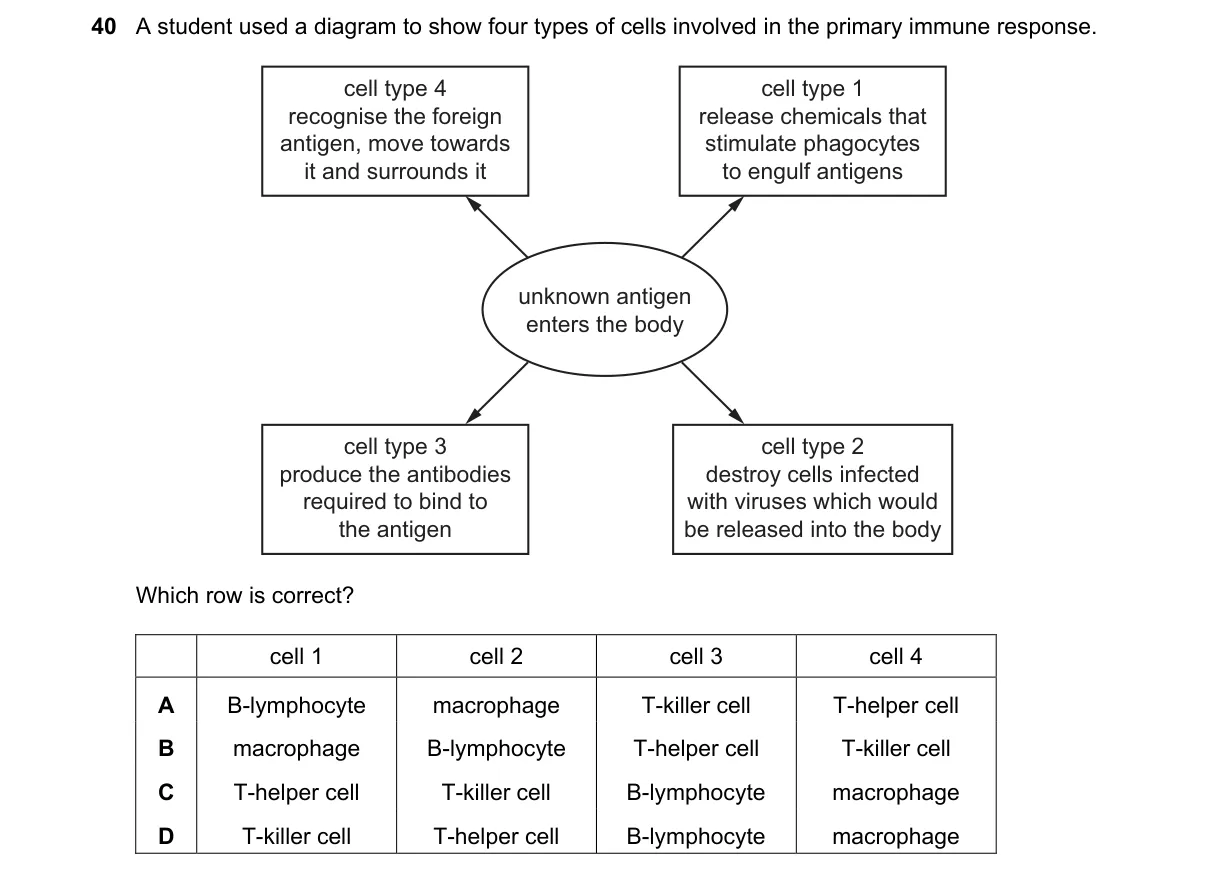
Answer choices
- Acell 1: B-lymphocyte, cell 2: macrophage, cell 3: T-killer cell, cell 4: T-helper cell
- Bcell 1: T-macrophage, cell 2: B-killer cell, cell 3: B-helper cell, cell 4: T-killer cell
- Ccell 1: B-macrophage, cell 2: T-killer cell, cell 3: B-lymphocyte, cell 4: macrophage
- Dcell 1: T-killer cell, cell 2: T-helper cell, cell 3: B-lymphocyte, cell 4: macrophage
Explanation
Matching immune cell functions in primary response
Steps:
- Identify cell 2 as the destroyer of virus-infected cells: cytotoxic T-killer cell.
- Identify cell 4 as the phagocyte that engulfs antigens: macrophage.
- Identify cell 1 as the cell binding antigens via receptors: B-lymphocyte.
- Identify cell 3 as the precursor producing more B-lymphocytes upon activation: B-lymphocyte.
Why C is correct:
- C aligns with immune definitions: B-lymphocytes bind antigens and proliferate, T-killer cells lyse infected cells, macrophages phagocytose via released enzymes.
Why the others are wrong:
- A: Macrophages do not destroy infected cells; T-killer cells do not produce B-lymphocytes; T-helper cells do not engulf.
- B: Invalid cell types like T-macrophage and B-killer cell do not exist.
- D: T-killer cells do not primarily bind free antigens; T-helper cells do not destroy infected cells.
Final answer: C
Topic: The immune system
Practice more A Levels Biology (9700) questions on mMCQ.me