A Levels Biology (9700)•9700/12/M/J/22
A Levels Biology (9700) — 9700/12/M/J/22, Question 34
Which row shows the change in concentration of some substances in red blood cells when carbon dioxide diffuses from active cells?
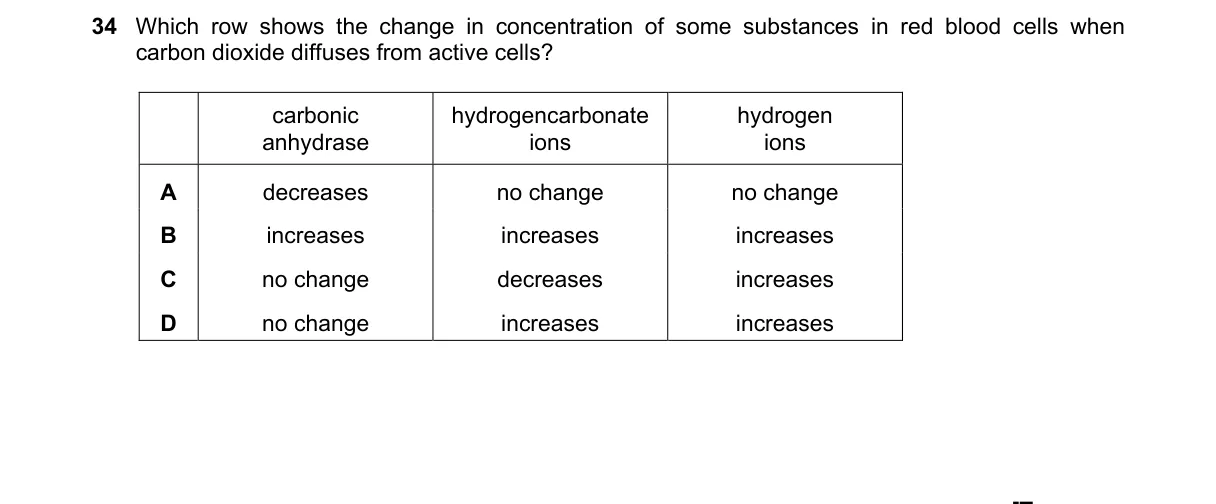
Answer choices
- Adecreases, no change, no change
- Bincreases, increases, increases
- Cno change, decreases, increases
- Dno change, increases, increases
Explanation
CO2 uptake and chloride shift in red blood cells
Steps:
- CO2 diffuses from active tissues into red blood cells (RBCs), increasing its concentration.
- Inside RBCs, CO2 reacts with water via carbonic anhydrase to form H+ and HCO3-.
- Hemoglobin buffers the H+, preventing a significant rise in [H+].
- HCO3- concentration increases due to formation; HCO3- then exits RBCs in exchange for Cl- entering via the chloride shift, raising [Cl-].
Why D is correct:
- D matches no change in [H+] (buffered by hemoglobin), increase in [HCO3-] (from carbonic acid dissociation), and increase in [Cl-] (chloride shift for charge balance).
Why the others are wrong:
- A: [HCO3-] and [Cl-] increase, not remain unchanged.
- B: [H+] shows no change due to buffering, not an increase.
- C: [H+] shows no change, not a decrease.
Final answer: D
Topic: Transport of oxygen and carbon dioxide
Practice more A Levels Biology (9700) questions on mMCQ.me