A Levels Biology (9700)•9700/12/M/J/22
A Levels Biology (9700) — 9700/12/M/J/22, Question 33
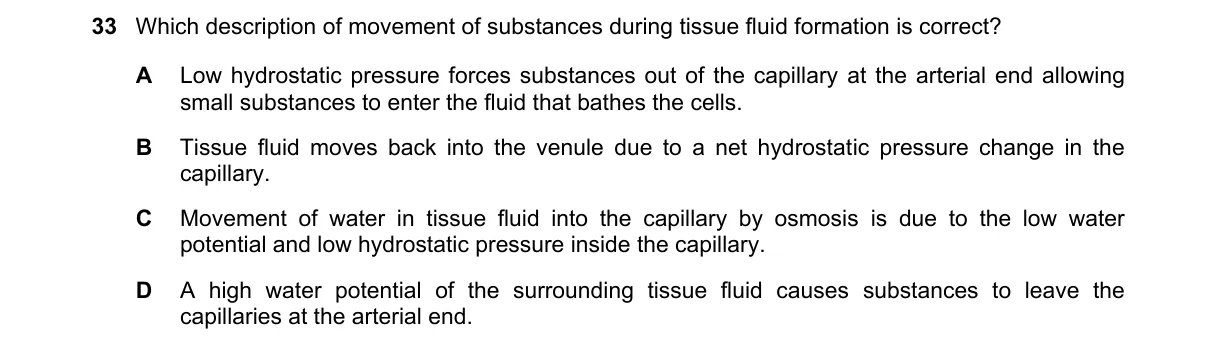
Which description of movement of substances during tissue fluid formation is correct?
Answer choices
- ALow hydrostatic pressure forces substances out of the capillary at the arterial end allowing
- Btissue fluid moves enter the venule due to a net hydrostatic pressure change in the
- CMovement of water into the capillary by osmosis is due to the low water
- DA high water potential at the arterial end surrounding tissue fluid causes substances leave the capillaries at the arterial end
Explanation
Capillary exchange via Starling's forces
Steps:
- Identify forces: Hydrostatic pressure pushes fluid out; oncotic pressure pulls it in via osmosis.
- At arterial end: High hydrostatic pressure exceeds oncotic, forcing fluid out into tissues.
- At venous end: Low hydrostatic allows oncotic pressure to dominate, drawing water back into capillary.
- Evaluate options against these principles to find the accurate description.
Why C is correct:
- Osmosis drives water into the capillary due to its lower water potential (from high protein concentration creating oncotic pressure), per the definition of water potential as the tendency of water to move from high to low potential.
Why the others are wrong:
- A: Hydrostatic pressure at arterial end is high, not low, forcing fluid out.
- B: Tissue fluid enters venules due to oncotic pressure, not just hydrostatic change.
- D: Surrounding tissue fluid has higher water potential, so substances leave capillaries due to hydrostatic pressure, not high tissue potential.
Final answer: C
Topic: The circulatory system
Practice more A Levels Biology (9700) questions on mMCQ.me