A Levels Biology (9700)•9700/12/M/J/22
A Levels Biology (9700) — 9700/12/M/J/22, Question 29
Which shows the correct sequence for the movement of sucrose into phloem tubes?
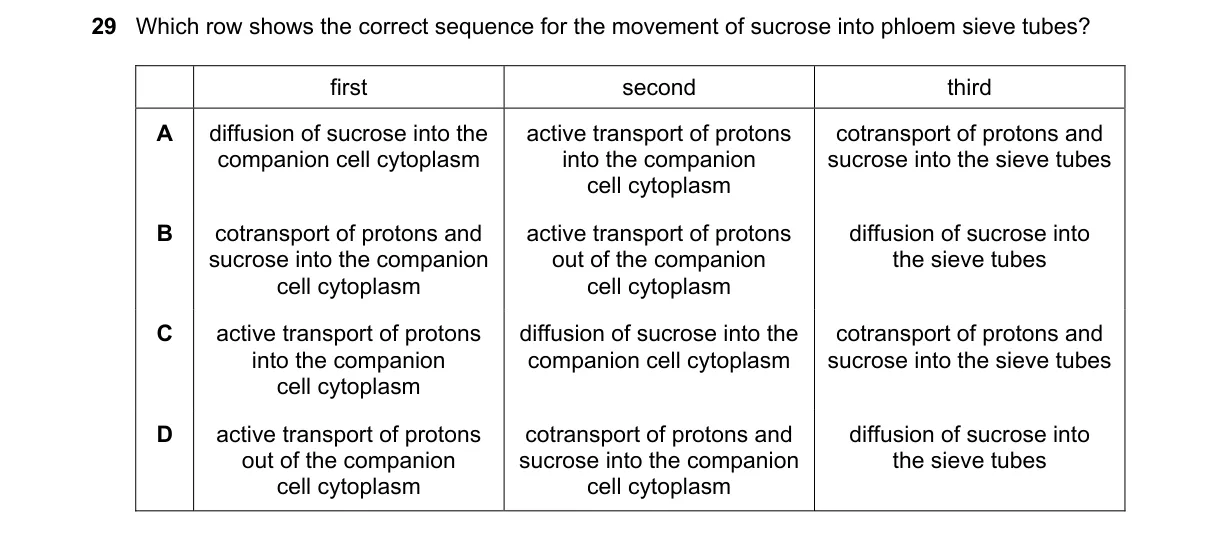
Answer choices
- Adiffusion sucrose into the companion cell cytoplasm; active transport of protons into the companion cell cytoplasm; diffusion of sucrose into sieve tubes
- Bcotransport of sucrose into the companion; active transport of protons out of the companion cell; diffusion of sieve tubes into
- Cactive transport cell transport into the companion cell cytoplasm; diffusion of sucrose into the companion cell cytoplasm; cotransport of protons and
- Dactive transport of protons out of the companion cell cytoplasm; cotransport of protons and; diffusion of sieve tubes into
Explanation
Phloem loading via proton-sucrose cotransport
Steps:
- Active transport pumps protons out of companion cells, creating an electrochemical gradient.
- Sucrose enters companion cells via cotransport with protons down the gradient.
- Sucrose diffuses from companion cells into sieve tubes.
- This sequence enables sucrose loading against its concentration gradient.
Why D is correct:
- Matches the proton gradient model, where H+-ATPase pumps protons out, driving symport of sucrose-H+ into companion cells, followed by diffusion into sieve tubes.
Why the others are wrong:
- A: Incorrect proton direction (into, not out) and omits cotransport.
- B: Reverses proton transport (out but cotransport misplaced) and garbles diffusion.
- C: Starts with wrong active transport of sucrose and confuses diffusion with cotransport.
Final answer: D
Topic: Transport mechanisms
Practice more A Levels Biology (9700) questions on mMCQ.me