A Levels Biology (9700)•9700/12/M/J/22
A Levels Biology (9700) — 9700/12/M/J/22, Question 28
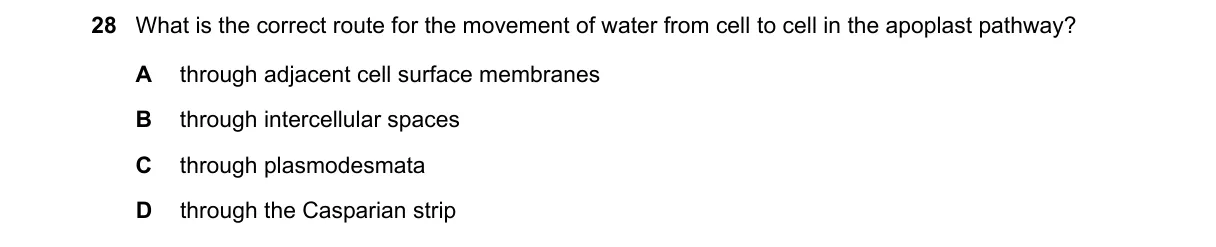
What is the correct route for the movement of water from cell to cell in the apoplast pathway?
Answer choices
- Athrough adjacent cell surface membranes
- Bthrough intercellular spaces
- Cthrough plasmodesmata
- Dthrough the Casparian strip
Explanation
Apoplast Pathway Relies on Cell Walls and Spaces
Steps:
- Recall that the apoplast pathway involves water movement through non-living parts of the plant, like cell walls and intercellular spaces.
- Distinguish apoplast from symplast: apoplast avoids crossing cell membranes, unlike symplast via cytoplasm.
- Identify key routes: water flows freely in cell walls and gaps between cells without entering protoplasts.
- Eliminate options requiring membrane crossing or specific barriers.
Why B is correct:
- The apoplast pathway is defined as water transport through the continuum of cell walls and intercellular spaces, allowing passive diffusion without cellular entry.
Why the others are wrong:
- A: Adjacent cell surface membranes are crossed in the symplast pathway, not apoplast.
- C: Plasmodesmata connect living cytoplasms in the symplast pathway.
- D: The Casparian strip blocks apoplast flow in roots, forcing symplast entry.
Final answer: B
Topic: Transport mechanisms
Practice more A Levels Biology (9700) questions on mMCQ.me