A Levels Biology (9700)•9700/12/M/J/22
A Levels Biology (9700) — 9700/12/M/J/22, Question 18
Telomeres prevent the loss of genes from the ends of chromosomes during DNA replication, but in cancer cells and stem cells, the telomeres remain the same length. Which statement is correct for all cells?
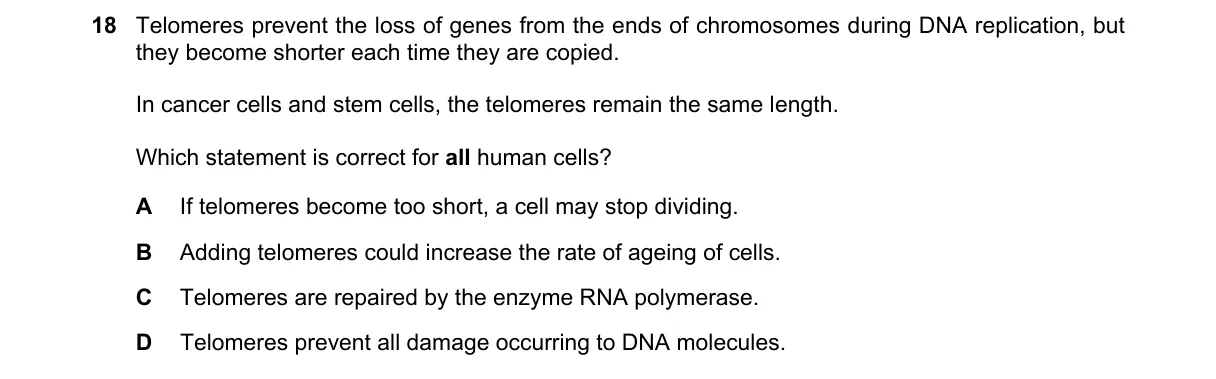
Answer choices
- AIf telomeres become too short, cell may stop dividing.
- BAdding telomeres could increase the rate of aging of cells.
- CTelomeres are repaired by enzyme RNA polymerase.
- DTelomeres prevent damage occurring to DNA molecules.
Explanation
Telomeres Regulate Cell Division Limits
Steps:
- Telomeres shorten with each DNA replication due to the end-replication problem.
- In most cells, progressive shortening triggers senescence when telomeres reach a critical length.
- Cancer and stem cells maintain telomere length via telomerase enzyme.
- Evaluate options: A matches senescence mechanism; others misstate telomere function or repair.
Why A is correct:
- Telomere shortening acts as a molecular clock, leading to the Hayflick limit where critically short telomeres induce p53-mediated cell cycle arrest, halting division.
Why the others are wrong:
- B: Longer telomeres delay senescence, slowing aging; adding them would extend cell lifespan.
- C: Telomeres are maintained by telomerase, a reverse transcriptase, not RNA polymerase.
- D: Telomeres cap ends to prevent fusion or degradation but do not broadly prevent DNA damage.
Final answer: A
Topic: Structure of nucleic acids and replication of DNA
Practice more A Levels Biology (9700) questions on mMCQ.me