A Levels Biology (9700)•9700/11/M/J/22
A Levels Biology (9700) — 9700/11/M/J/22, Question 6
Samples of glucose, sucrose, and a mixture of glucose and sucrose were divided into two halves M and N. M was tested with Benedict's solution. N was boiled with dilute hydrochloric acid, neutralised and then tested with Benedict's solution. The colour of the solution was compared to colour standards. Which table identifies the correct colour changes for these samples?
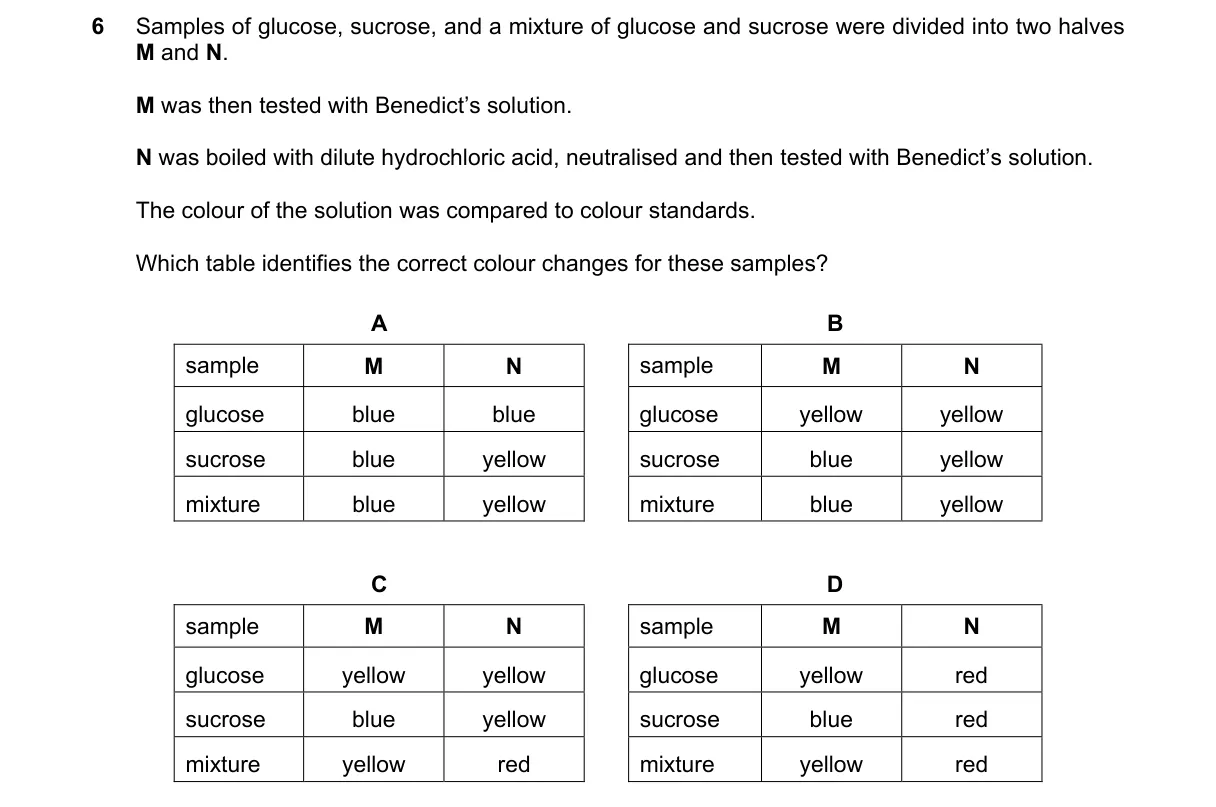
Answer choices
- Asample M N sucrose blue yellow mixture blue yellow
- Bsample M N sucrose yellow yellow mixture blue yellow
- Csample C N glucose yellow yellow sucrose blue yellow mixture blue red
- Dsample D N glucose yellow red sucrose blue red mixture yellow red
Explanation
Benedict's Test for Reducing Sugars Steps:
- Glucose is a reducing sugar, reacts with Benedict's to give yellow precipitate in both M (direct) and N (after acid, no change).
- Sucrose is non-reducing, remains blue in M; acid hydrolysis breaks it into glucose and fructose (reducing), giving yellow in N.
- Mixture of glucose and sucrose gives blue in M (sucrose dominates, minimal reaction); in N, hydrolysis adds more reducing sugars, yielding red (stronger positive). Why C is correct:
- Matches reducing property: glucose positive both ways; sucrose negative then positive; mixture weak/negative initially, strong positive after hydrolysis (color intensity reflects sugar amount). Why the others are wrong:
- A: Omits glucose; mixture M blue correct but N yellow understates added sugars' effect.
- B: Sucrose M yellow wrong (non-reducing); mixture M blue but omits glucose data.
- D: Glucose N red wrong (acid doesn't increase its reducing power); all positives same intensity ignores hydrolysis boost. Final answer: C
Topic: Testing for biological molecules
Practice more A Levels Biology (9700) questions on mMCQ.me