A Levels Biology (9700)•9700/11/M/J/22
A Levels Biology (9700) — 9700/11/M/J/22, Question 34
Which statement explains the importance of the chloride shift in red blood cells (RBC)?
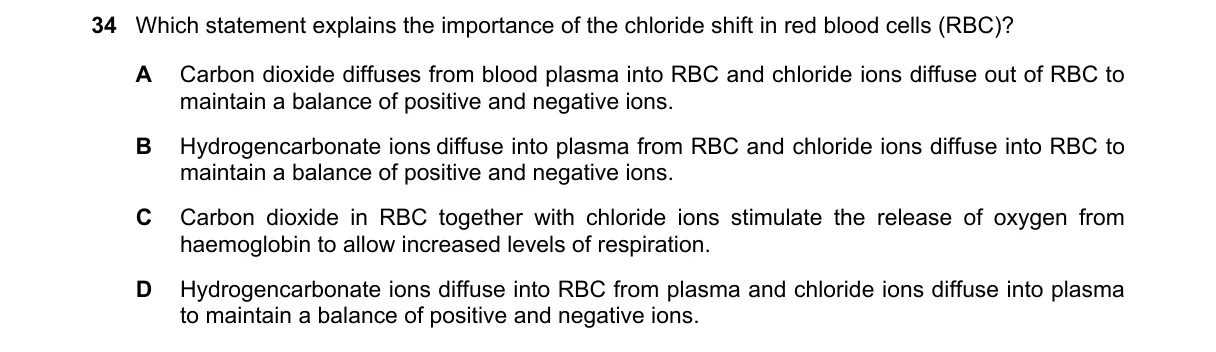
Answer choices
- ACarbon dioxide diffuses from blood plasma into RBC and chloride ions diffuse out of RBC
- BHydrogencarbonate ions diffuse from RBC and negative ions from RBC and chloride ions diffuse into RBC
- CHaemoglobin to in RBC levels with chloride ions stimulate the release of oxygen from
- DHydrogencarbonate ions into RBC from plasma and chloride ions diffuse into plasma to maintain a balance of positive and negative ions
Explanation
Chloride Shift Maintains Charge Balance in CO2 Transport
Steps:
- CO2 diffuses into RBC and reacts with water via carbonic anhydrase to form H2CO3, which dissociates into H+ and HCO3-.
- H+ is buffered by hemoglobin, allowing HCO3- to diffuse out of RBC into plasma.
- To preserve electrical neutrality, Cl- ions shift into RBC from plasma.
- This exchange enables efficient CO2 transport as HCO3- in plasma.
Why B is correct:
- It accurately describes the chloride shift, where HCO3- exits RBC and Cl- enters to balance ions, per the definition of anion exchange in erythrocytes.
Why the others are wrong:
- A: Reverses Cl- direction; Cl- enters RBC, not exits.
- C: Confuses chloride shift with Bohr effect, which involves H+ influencing O2 release, not Cl- directly.
- D: Inverts HCO3- flow; HCO3- exits RBC into plasma, not vice versa.
Final answer: B
Topic: Transport of oxygen and carbon dioxide
Practice more A Levels Biology (9700) questions on mMCQ.me