A Levels Biology (9700)•9700/11/M/J/22
A Levels Biology (9700) — 9700/11/M/J/22, Question 24
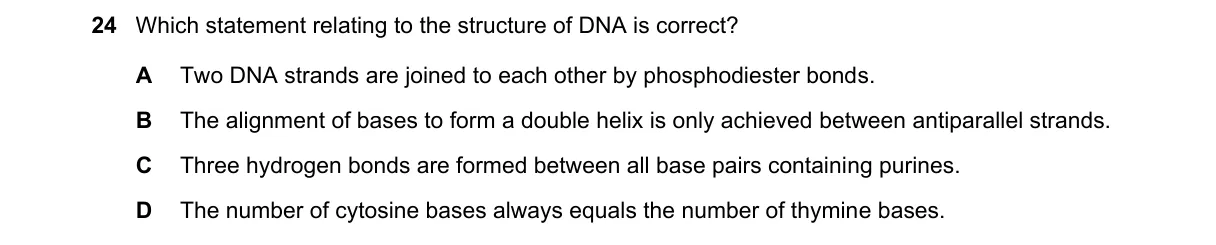
Which statement relating to the structure of DNA is correct?
Answer choices
- ATwo DNA strands are joined to each other by phosphodiester bonds.
- BThe alignment of bases form double helix only between antiparallel strands.
- CThree hydrogen bonds are formed between all base pairs containing purines.
- DThe number of cytosine bases always equals the number of thymine bases.
Explanation
DNA's Antiparallel Double Helix
Steps:
- Recall DNA structure: two polynucleotide strands form a double helix, linked by hydrogen bonds between complementary bases.
- Note strands are antiparallel, running in opposite 5' to 3' directions for proper base pairing and helix formation.
- Evaluate options: A confuses intra-strand bonds; B matches antiparallel requirement; C misstates hydrogen bonds; D ignores base pairing rules.
- Confirm B as correct via standard Watson-Crick model.
Why B is correct:
- DNA double helix requires antiparallel strands for base alignment and stability, as defined in the Watson-Crick model.
Why the others are wrong:
- A: Phosphodiester bonds link nucleotides within each strand; hydrogen bonds join strands.
- C: Purine-pyrimidine pairs form 2 H-bonds (A-T) or 3 (G-C), not 3 for all purine-involved pairs.
- D: Chargaff's rules state cytosine equals guanine, not thymine.
Final answer: B
Topic: Structure of nucleic acids and replication of DNA
Practice more A Levels Biology (9700) questions on mMCQ.me