A Levels Biology (9700)•9700/11/M/J/22
A Levels Biology (9700) — 9700/11/M/J/22, Question 17
Four blocks of agar containing cresol red were cut to different sizes measured in millimeters. Four blocks were submerged in acid. All other variables were kept constant. The time for each of the four blocks to completely turn yellow was recorded. Which of the four blocks turned completely yellow most quickly?
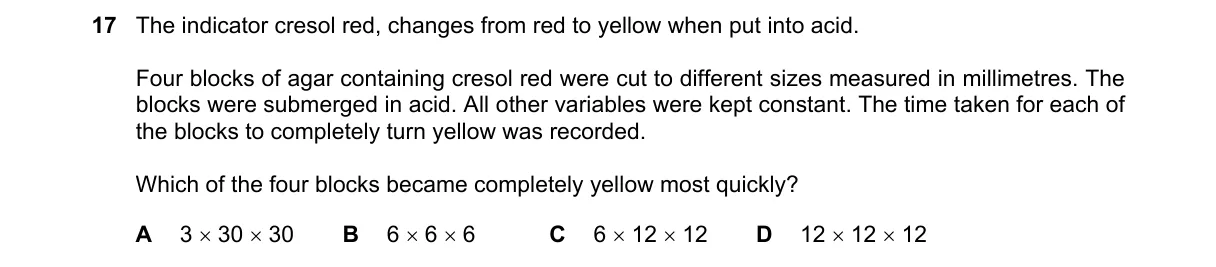
Answer choices
- A3 x 30
- B6 x 6
- C12 x 12
- D12 x 12
Explanation
Diffusion rate depends on minimum dimension
Steps:
- Acid diffuses from surfaces to center; time depends on distance to center (half the smallest dimension).
- For A (3 x 30 mm): smallest dimension 3 mm, distance 1.5 mm.
- For B (6 x 6 mm cube): smallest dimension 6 mm, distance 3 mm.
- For C/D (12 x 12 mm cubes): smallest dimension 12 mm, distance 6 mm.
- Smallest distance means fastest complete color change.
Why A is correct:
- Thinnest block has shortest diffusion path to center, per Fick's law of diffusion (rate inversely proportional to distance squared).
Why the others are wrong:
- B: Twice the diffusion distance of A, so slower color change.
- C: Four times the distance of A, much slower.
- D: Identical to C, same slow rate.
Final answer: A
Topic: Movement into and out of cells
Practice more A Levels Biology (9700) questions on mMCQ.me