A Levels Biology (9700)•9700/11/M/J/22
A Levels Biology (9700) — 9700/11/M/J/22, Question 13
A student completed an experiment to measure how increasing concentrations of substrate affect the rate of an enzyme-controlled reaction. The student then repeated the experiment after adding a fixed quantity of a reversible competitive inhibitor. Which row describes the effect of adding the inhibitor on enzyme activity?
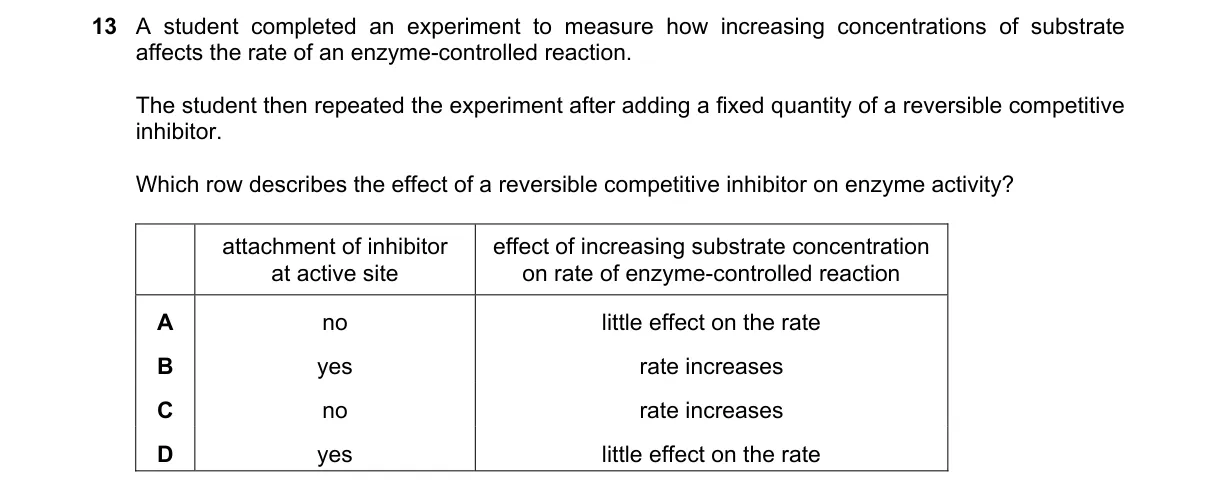
Answer choices
- Aattaches to the active site: no; effect on rate of enzyme-controlled reaction: little effect on the rate
- Battaches to the active site: yes; effect on rate of enzyme-controlled reaction: rate increases
- Cattaches to the active site: no; effect on rate of enzyme-controlled reaction: rate increases
- Dattaches to the active site: yes; effect on rate of enzyme-controlled reaction: little effect on the rate
Explanation
Competitive Inhibition in Enzyme Kinetics
Steps:
- Identify inhibitor type: reversible competitive inhibitor binds to the enzyme's active site, competing with substrate.
- Analyze attachment: it directly occupies the active site, preventing substrate binding temporarily.
- Evaluate rate effect: inhibitor increases Km (apparent lower affinity), but Vmax remains unchanged as high substrate displaces inhibitor.
- Compare to experiment: with increasing substrate concentrations, maximum rate is unaffected, showing little overall effect on peak enzyme activity.
Why D is correct:
- Competitive inhibitors bind the active site (yes) and allow full Vmax recovery with excess substrate, per Michaelis-Menten kinetics, resulting in little effect on maximum rate.
Why the others are wrong:
- A: Incorrect; competitive inhibitors do attach to the active site.
- B: Incorrect; rate does not increase—inhibitor reduces rate at low substrate but max rate unchanged.
- C: Incorrect; competitive inhibitors attach to the active site and do not increase rate.
Final answer: D
Topic: Mode of action of enzymes
Practice more A Levels Biology (9700) questions on mMCQ.me