A Levels Biology (9700)•9700/13/M/J/21
A Levels Biology (9700) — 9700/13/M/J/21, Question 33
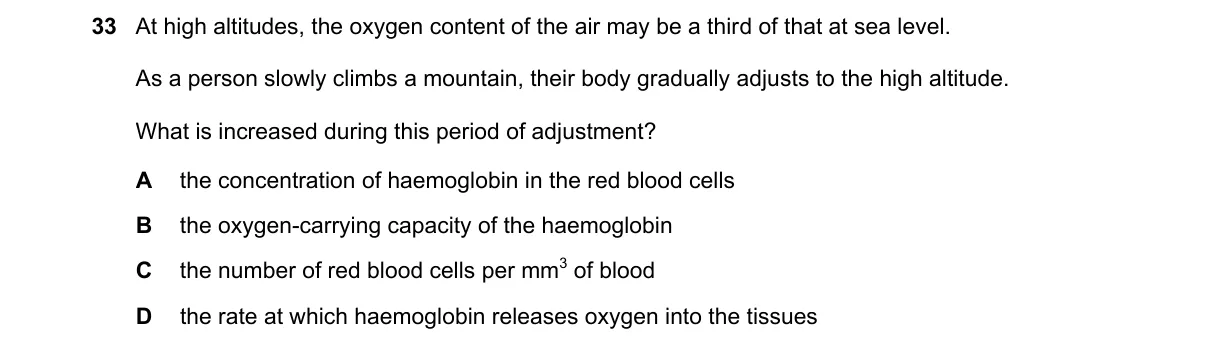
At high altitudes, the oxygen content of the air may be a third of that at sea level. As a person slowly climbs a mountain, their body gradually adjusts to the high altitude. What is increased during this period of adjustment?
Answer choices
- Athe concentration of hemoglobin in the red blood cells
- Bthe oxygen-carrying capacity of hemoglobin in the red blood cells
- Cthe number of red blood cells per mm³ of blood
- Dthe rate at which hemoglobin releases oxygen into the tissues
Explanation
High-altitude acclimatization via increased erythropoiesis
Steps:
- Low oxygen at high altitudes causes hypoxia, detected by kidney cells.
- Kidneys release erythropoietin (EPO) hormone in response.
- EPO stimulates bone marrow to produce more red blood cells (RBCs).
- Increased RBCs enhance total blood oxygen-carrying capacity.
Why C is correct:
- Erythropoietin directly boosts RBC production, raising their count per mm³ to transport more oxygen, as defined in hypoxic physiological adaptation.
Why the others are wrong:
- A: Hemoglobin concentration within each RBC stays fixed at about 34% by weight.
- B: Each hemoglobin molecule's oxygen-binding sites remain unchanged at four per molecule.
- D: Hemoglobin's oxygen release rate adjusts via Bohr effect but isn't the primary acclimatization mechanism.
Final answer: C
Topic: Transport of oxygen and carbon dioxide
Practice more A Levels Biology (9700) questions on mMCQ.me