A Levels Biology (9700)•9700/13/M/J/21
A Levels Biology (9700) — 9700/13/M/J/21, Question 19
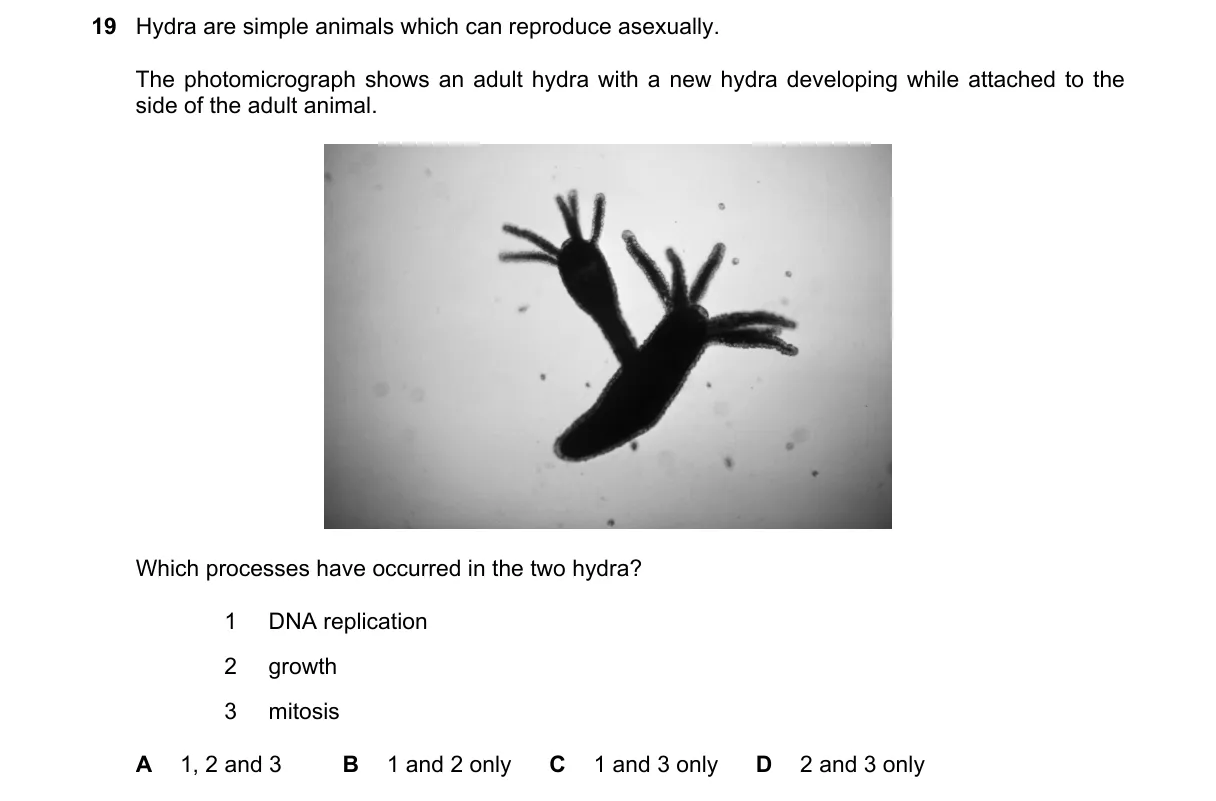
The photomicrograph shows an adult hydra with a new hydra developing while attached to the side of the adult animal. Which processes have occurred in the two hydra? 1 DNA replication 2 growth 3 mitosis
Answer choices
- A1 and 2 only
- B1 and 3 only
- C2 and 3 only
- D1, 2 and 3
Explanation
Hydra budding involves DNA replication and growth
Steps:
- Identify the process as asexual budding in hydra, where a new individual forms on the parent.
- Note that DNA replication occurs in the parent's cells to provide genetic material for the bud.
- Observe that the bud enlarges through cellular growth and differentiation.
- Conclude that mitosis, while typically involved earlier, is not a distinct process evident in the attached developing stage shown.
Why A is correct:
- Budding requires DNA replication to copy parental genome and growth to form the bud structure, per standard cnidarian reproduction definitions.
Why the others are wrong:
- B omits growth, essential for bud development from a small outgrowth to a full hydra.
- C excludes DNA replication, needed to equip bud cells with identical genetic information.
- D includes mitosis, which precedes but does not actively occur in the visible attached development phase.
Final answer: A
Topic: Replication and division of nuclei and cells
Practice more A Levels Biology (9700) questions on mMCQ.me